
Preventative Botox: Is Starting in Your 20s Worth It?
The trouble is that the pitch skips the part you actually need. Preventative Botox is not one decision. It is a decision you repeat two or three times a year, for as long as you want the effect to hold. Starting at 24 instead of 34 means roughly thirty extra appointments and a bill that grows with them.
This guide walks through what the treatment can and cannot do, and how the science actually reads. It covers what the commitment costs at our Youngsville studio, and how to tell whether your face is giving you a reason to start. Our goal is to help you decide clearly, including deciding that now is not your time.
What Is Preventative Botox?
Preventative Botox: the use of botulinum toxin type A injections in younger adults to limit muscle movement before repeated expressions etch a permanent line into the skin. Some clinics call it prejuvenation or prophylactic Botox. The product, the technique, and the safety profile match standard cosmetic Botox. Only the starting point changes.
How Preventative Botox Works
Botulinum toxin type A blocks the release of acetylcholine at the junction between nerve and muscle. Without that chemical signal, the treated muscle contracts with less force. The skin sitting above it folds less sharply each time you frown, squint, or raise your brows.
The effect is temporary and local. It builds over roughly a week and reaches full strength around two weeks after injection. Nerve endings gradually reconnect with the muscle, and normal movement returns. According to the FDA-approved prescribing information, reduced glabellar line severity was measured for up to 120 days in clinical studies, which is where the familiar three- to four-month figure comes from.
The prevention idea rests on one step further. If the fold never happens, the crease never sets. That reasoning is sound as far as it goes, and it is also where the certainty ends.
Dynamic Lines vs. Static Wrinkles
This distinction decides almost everything about your timing, so it is worth checking in a mirror before you read further. Relax your face completely. Look for any line that stays.
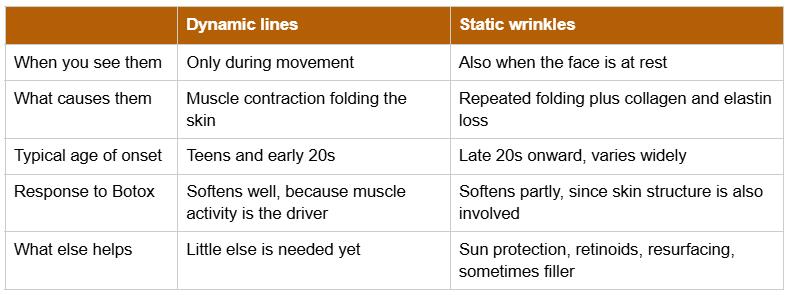
Everyone has dynamic lines. They are simply a face working normally. The moment worth paying attention to is when a dynamic line stops disappearing. That faint shadow at rest is the crease beginning to set, and it is the honest starting point for a preventative conversation.
How It Differs From Traditional Botox
There is no separate preventative formula. The vial used on a 26-year-old with faint frown lines is the same vial used on a 52-year-old with deep ones. Three practical differences usually show up instead.
- Dose. Younger patients typically receive fewer units, because the target muscles are often weaker and the goal is softening rather than correction.
- Goal. Standard treatment reduces a line you can already see at rest. Preventative treatment aims to keep one from forming.
- Regulatory footing. Botox Cosmetic is approved for moderate to severe lines in adults. Treating mild or barely visible lines is an off-label use.
Off-label does not mean unsafe or improper. It means the specific use sits outside what the manufacturer studied and the FDA reviewed, so the decision rests on your provider's clinical judgment rather than on label evidence. You deserve to know which of those two you are relying on, and any good injector will tell you plainly.
How Do Wrinkles Form?
Facial lines come from two separate processes running at the same time. Botox addresses one of them. Understanding which is which explains why injections alone never produce the result people imagine.
How Repeated Facial Movements Create Expression Lines
Your face carries dozens of muscles attached directly to skin rather than to bone. Every expression pleats the skin along the same lines, thousands of times a year. Young skin springs back because collagen and elastin hold their shape well.
As that elastic recovery slows, the pleat starts to hold a little longer each time. Eventually it stops flattening out completely, and a dynamic line becomes a static one. This is why the deepest expression lines follow personal habits so closely. Habitual squinters develop crow's feet earlier. People who frown while concentrating develop the vertical "11" lines earlier.
The Role of Collagen, Sun Exposure, and Skin Aging
Muscle movement supplies the fold. Skin quality decides whether the fold becomes permanent, and that half is governed largely by things Botox never touches.
Ultraviolet exposure is the dominant modifiable factor. UV radiation degrades collagen and elastin in the dermis, which is why sun-exposed skin lines earlier and more deeply than protected skin. The American Academy of Dermatology lists daily sun protection first among steps to reduce premature skin aging, alongside avoiding tanning beds and not smoking.
Natural collagen decline, genetics, sleep, and repeated squinting in bright light all contribute as well. In humid, sunny South Louisiana, year-round sun exposure matters more than most people assume, including on overcast days and during errands rather than beach trips.
Here is the practical consequence. A 20-something who skips sunscreen but books Botox every four months has treated the smaller half of the problem while leaving the larger half running.
Book Into our Symetrie Studio Spa
Ready to take the next step? Book a consultation with a qualified permanent makeup artist.
Book Now
Book Into our Symetrie Studio Spa
Ready to take the next step? Book a consultation with a qualified permanent makeup artist.
Book Now
Why Dosing Should Always Be Individualized
A fixed unit count applied to everyone ignores the things that actually determine outcome: muscle strength, injection depth, brow position, facial symmetry, prior treatment history, and what you personally want to keep moving.
Brow position deserves particular attention in younger patients. The frontalis muscle holds the brows up, so over-relaxing the forehead can drop the brow and make the eyes look heavier. That risk is one reason forehead and frown lines are usually assessed together rather than treated in isolation. At our studio, injections are performed by licensed nurse practitioners or registered nurses, and dosing is mapped during a private consultation that includes a full medical history review.
What Are the Risks and Drawbacks?
Cosmetic botulinum toxin has a long safety record when a qualified professional administers it, and most side effects are mild and temporary. It is still a prescription medicine with a boxed warning, and the risks are worth reading rather than skimming.
Common Side Effects and Potential Complications
Reactions at the treated area are the most frequent issue and generally settle within hours to days.
- Bruising, swelling, redness, or tenderness at injection sites.
- Headache in the days following treatment.
- Eyelid drooping (ptosis) or brow asymmetry, which resolves as the effect wears off.
- Temporary heaviness or a mildly altered smile if the product affects a nearby muscle.
The serious risk is rarer and more important. The FDA Medication Guide carries a boxed warning that the effects of botulinum toxin may spread from the injection area, producing symptoms such as generalized muscle weakness, double vision, drooping eyelids, and difficulty swallowing, speaking, or breathing. These can appear hours to weeks after injection and require immediate medical attention. No definitive serious reports of distant spread have been linked to the labeled cosmetic doses, but the warning applies to all botulinum toxin products.
Botox Cosmetic is contraindicated in people with a known hypersensitivity to any botulinum toxin preparation or to any component of the formulation, and where there is an infection at the proposed injection site. Injector skill and product authenticity both matter here, so it is fair to ask who is injecting you, what their license is, and where the product came from.
Can Botox Affect Natural Facial Expressions?
Yes, and that is precisely the mechanism, so the goal is calibration rather than elimination. Well-dosed treatment softens the depth of a fold while leaving enough movement that your face still reads as yours.
The frozen appearance people worry about generally comes from too much product, poor placement, or treating too many areas at once, rather than from the drug itself. Since results are temporary, an unsatisfying outcome is not permanent, though waiting out three or four months is genuinely frustrating. Starting lighter is the practical protection against that.
Why Over-Treatment Can Create an Unnatural Appearance
Facial muscles work in opposing pairs, and heavily relaxing one lets its counterpart pull unopposed. Over-treating the forehead can lower the brows. Treating the frown complex too aggressively while ignoring the frontalis can raise the outer brow into an arched, surprised look.
There is also a subtler drawback specific to early starters. Beginning at a high dose in your 20s leaves nowhere to go later, when muscles are stronger, and lines are deeper. Starting light preserves that room.
How Much Does Preventative Botox Cost?
Cost is where preventative treatment differs most sharply from corrective treatment, because you are committing to a recurring expense far earlier in life. The honest number is not the price of one session.
Factors That Affect Botox Pricing
The American Society of Plastic Surgeons reports an average cost of $435 for botulinum toxin injections nationally. It notes that the figure shifts with how much product is used, the qualifications of the person treating you, and office location. Several specific factors drive your own number.
- Units used. The largest factor by far, since the product is the main cost.
- Areas treated. Frown lines alone cost far less than a full upper face.
- Product selected. Botox, Dysport, and Jeuveau carry different per-unit prices and different unit systems.
- Pricing model. Per-unit pricing shows you exactly what you received. Per-area pricing is simpler but hides the dose.
- Injector credentials and the standards of the practice.
Our current pricing at Symetrie Studio Spa is per unit, so you always know what you are paying for: Botox at $13.25 per unit, Jeuveau at $10.75 per unit, and Dysport at $5.00 per unit. Dysport looks dramatically cheaper on that line, but its units are defined differently, and more of them are typically needed, so the per-unit figures cannot be compared directly. Ask for the total for your plan instead.
How Treatment Frequency Affects Long-Term Cost
Results last around three to four months, which means roughly three sessions a year to maintain them. The table below applies our per-unit Botox pricing to common dose ranges so you can see the shape of the commitment. Your actual dose is set at consultation.
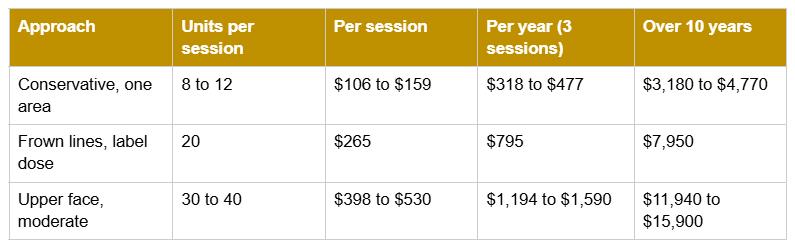
Two things stand out. Starting a decade earlier adds a full decade of that cost rather than replacing anything. And the total is not fixed, since muscles change and doses are adjusted over time.
We accept major credit cards and offer financing through CareCredit, Affirm, Afterpay, and Cherry. That said, if a treatment only works within a payment plan, waiting is usually the sounder call. Preventative Botox is elective, and skipping sessions during a tight year simply lets the effect fade.
What Happens If You Stop Preventative Botox?
This question worries people more than any other, and the honest answer is reassuring. Stopping returns you to your natural trajectory. It does not punish you for having started.
Will Your Wrinkles Come Back?
Movement returns gradually as nerve endings reconnect with the muscle, usually over three to four months. Lines you had before treatment come back with it, and they return to where your face would have been, not to something worse.
If you treated consistently for several years and genuinely slowed the etching of a line, that benefit does not vanish the day you stop. The skin simply resumes aging normally from that point.
Does Stopping Botox Make You Age Faster?
No. This is one of the most persistent myths in aesthetics, and there is no evidence that discontinuing botulinum toxin accelerates skin aging.
The impression comes from contrast. After months of a smoother forehead, the return of normal movement feels like a sudden decline, when it is really a return to baseline plus whatever aging happened in the meantime. Photographs from before your first treatment are the fairest comparison, and they usually settle the question.
What Happens When Muscle Movement Returns
The return is gradual rather than sudden. Movement typically reappears first as a slight ability to contract, then strengthens over several weeks until the muscle works normally again.
Some people notice the treated muscle feels weaker than it did originally, particularly after years of regular treatment, though this is a clinical observation rather than a well-quantified effect. Whether you continue is a decision you get to revisit at every appointment. There is no course to complete and no penalty for stopping.
Preventative Botox vs. Skincare
These are not competing options, and framing them as either-or leads people to spend money in the wrong order. Skincare addresses skin quality and sun damage. Botox addresses muscle movement. Only one of them has to come first.
Daily Sunscreen and Sun Protection
If you do one thing for the way your face looks in twenty years, this is it. UV exposure drives the collagen breakdown that turns a temporary fold into a permanent crease, and it is almost entirely within your control.
The American Academy of Dermatology recommends a broad-spectrum, water-resistant sunscreen with SPF 30 or higher, applied to all skin not covered by clothing. Sunscreen alone is not the whole plan. The AAD also advises seeking shade, wearing sun-protective clothing, and using sunglasses with UV protection, which has the added benefit of reducing the squinting that deepens crow's feet.
Daily means daily, including cloudy days and short trips outside. In this part of Louisiana, incidental sun adds up quickly across the year.
Retinoids and Other Evidence-Based Skincare
Retinoids are the most established topical ingredient for the signs of skin aging, and they work on half of the problem Botox cannot reach by supporting cell turnover and collagen.
The AAD's guidance on retinoids and retinol suggests starting with the least intense formulation available and using it every other night at first, building up slowly, since going too fast usually ends in irritation. Because retinoids increase sun sensitivity, apply them at night and pair them with daytime sun protection. Results take months rather than weeks, and topical retinoids are generally avoided during pregnancy.
A simple, consistent routine outperforms an elaborate one you abandon. Cleanser, moisturizer, sunscreen every morning, and a retinoid at night cover the evidence-backed essentials.
Healthy Lifestyle Habits for Skin Aging
The AAD's guidance on reducing premature skin aging includes several habits that cost nothing.
- Do not smoke. Smoking is strongly associated with earlier facial wrinkling.
- Skip tanning beds, which emit the same UV radiation that ages skin and raises skin cancer risk.
- Reduce repetitive squinting, for instance by wearing sunglasses outdoors and keeping your vision prescription current.
- Be gentle with your skin, avoiding scrubbing and products that sting or burn.
- Eat a balanced diet and protect your sleep.
Why Botox Should Not Replace Good Skincare
A relaxed muscle under sun-damaged skin still produces a face that looks older than it should. Injections do not build collagen, prevent pigmentation, or protect against UV damage, so treating without the foundation leaves the larger process untouched.
The sensible sequence is straightforward. Establish sun protection and a retinoid first, give it a few months, then reassess your face at rest. Many people find the urgency they felt has faded. Those who still see a line at that point are making a much better-informed decision.
Who Should Avoid or Delay Preventative Botox?
Elective treatment is easy to postpone, which makes caution inexpensive here. Some circumstances call for delay, and others require a medical conversation before anything is scheduled.
Pregnancy and Breastfeeding Considerations
Pregnancy is not listed among the contraindications in Botox Cosmetic labeling, so it is not accurate to call it an absolute medical prohibition. The label does state that in animal studies, administration during pregnancy produced adverse effects on fetal growth at clinically relevant doses, and that it is not known whether the product passes into human breast milk.
Given a purely cosmetic benefit and incomplete safety data, most providers defer treatment during pregnancy and breastfeeding. That is a caution grounded in professional judgment rather than a formal restriction, and the distinction is worth understanding. If you are pregnant, nursing, or planning to conceive soon, tell your provider and discuss it with your obstetrician.
Medical Conditions and Medications to Discuss With Your Provider
Share your full medical history before treatment, including anything that seems unrelated. Several items specifically change the risk picture.
- Neuromuscular disorders such as myasthenia gravis, Lambert-Eaton syndrome, or ALS. The label states that patients with these conditions may face increased risk of significant effects, including generalized weakness and swallowing or breathing difficulty.
- Existing swallowing or breathing difficulties, which may make complications more likely.
- Aminoglycoside antibiotics or other agents that interfere with neuromuscular transmission, since they may potentiate the toxin's effect.
- Blood thinners and regular NSAIDs, which raise bruising risk. Never stop a prescribed blood thinner without approval from the doctor who prescribed it.
- Previous reaction to any botulinum toxin product, or allergy to formulation components including human albumin.
- Active infection, acne, or a skin condition at the planned injection site.
Why Individual Medical Assessment Matters
No article can tell you whether you are a suitable candidate, because suitability depends on an examination. A provider needs to watch your face move, assess muscle strength and brow position, review your history and medications, and confirm your goals are realistic.
That assessment also protects you from being treated for the wrong reason. A good consultation should be willing to conclude that you do not need treatment yet, and you should be comfortable leaving without booking.
What Areas Are Typically Treated
Preventative treatment in younger patients concentrates on the upper face, where expression muscles fold skin most sharply. Three areas cover almost all early treatment, and all three fall within Botox Cosmetic's approved cosmetic indications.
- Glabellar lines, the vertical "11" lines between the brows. Usually the first place a resting line appears, and the most common starting point for younger patients.
- Forehead lines, the horizontal lines from raising your brows. Treated carefully and often alongside the frown area, since the frontalis holds the brows up.
- Crow's feet, the lines fanning from the outer corners of the eyes when you smile or squint. Frequently earlier in people who spend a lot of time in bright light.
Most younger patients begin with one area rather than all three. You can see how your face responds, judge how long the result holds, and expand later if it makes sense. Our Botox, Jeuveau, and Dysport page covers how each product is used across these areas, along with onset, duration, and aftercare.
Conclusion
Preventative Botox is worth it for some people in their 20s and premature for many others, and the deciding factor is visible in a mirror rather than on a birth certificate. If a line lingers after your face relaxes, early treatment has a defensible rationale. If your face is smooth at rest, you are treating a forecast, and the evidence supporting that is thinner than the marketing implies.
Keep the trade-offs in view. This is a recurring commitment of roughly three sessions a year for as long as you want the effect. It addresses muscle movement and nothing else, which leaves sun protection and retinoids doing the larger share of the work. Stopping is always available and carries no penalty.
If you want a clear answer for your own face, we would rather examine it than guess. Symetrie Studio Spa offers complimentary consultations on all services at our Youngsville studio, serving clients across Lafayette and the greater Acadiana area. A licensed nurse practitioner or registered nurse will review your medical history, assess your face in motion and at rest, and give you a straight recommendation, including telling you if waiting is the better choice.
Book your complimentary consultation online, or call us at (337) 534-0852 with any questions before you decide.
Book Into our Symetrie Studio Spa
Ready to take the next step? Book a consultation with a qualified permanent makeup artist.
Book Now