Nano Brows vs Powder Brows: What's the Difference?
Quick Comparison Table
Why Do People Confuse Nano Brows and Powder Brows?
Both techniques use a PMU (permanent makeup) machine, which trips people up immediately. Because the tool looks the same from the outside, many clients assume the results will be similar too.
The critical difference is the needle configuration and the application method. Nano brows use a single, ultra-fine needle to draw strokes. Powder brows use a grouping of needles to deposit pigment in soft dots across the brow area.
The other source of confusion is terminology. Some artists call nano brows "nano needling," "machine hair strokes," or "nano feathering." Some call powder brows "ombre brows," "pixel brows," or "shaded brows." The branding varies by studio and region, but the core techniques remain consistent.
Which Brow Technique Looks More Natural?
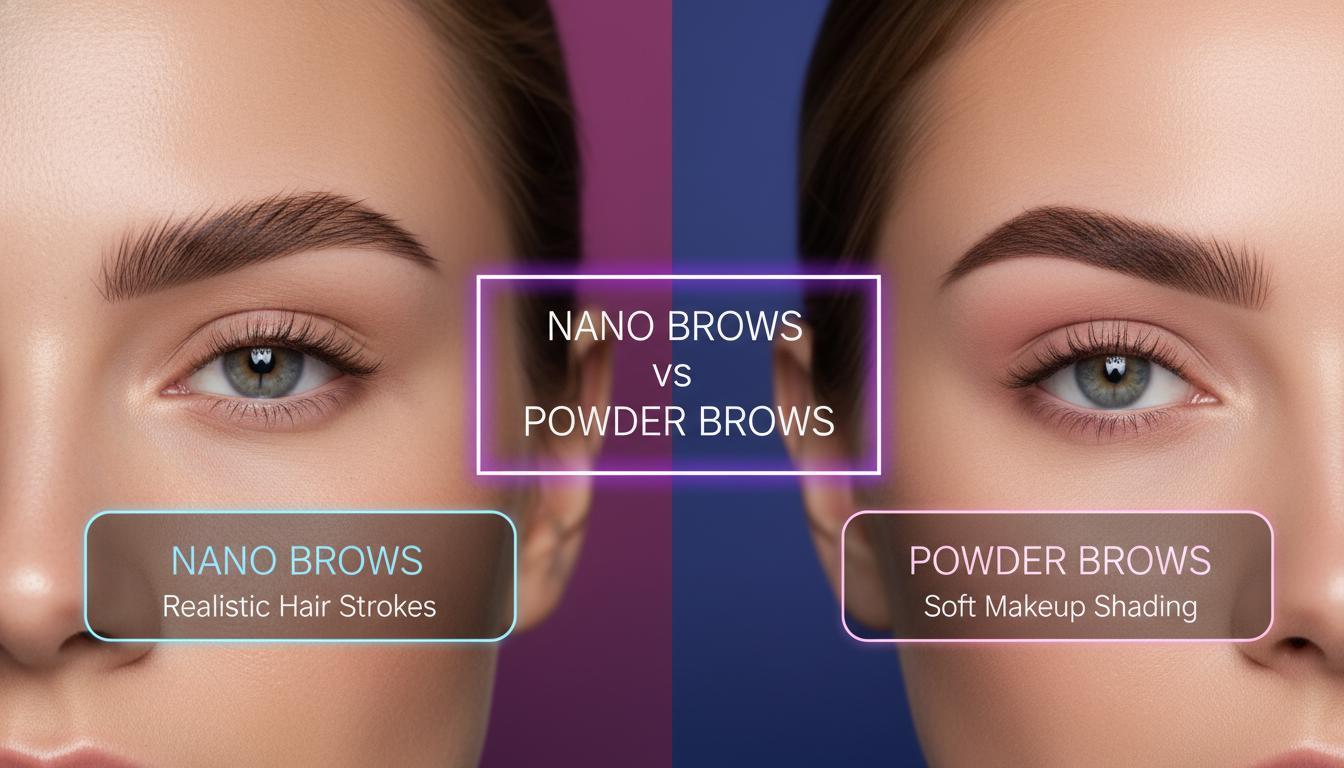
Nano brows generally look more natural up close because each stroke mimics a real brow hair. Powder brows look more polished and made-up, similar to having filled in your brows with a powder or pencil.
Neither is more natural in an absolute sense. It depends on your natural brow density and the look you want. Someone with fuller natural brows and sparse gaps may love the nano result. Someone with very little natural brow hair often prefers powder brows because they fill the space more evenly.
Which Technique Lasts Longer?
Powder brows typically last longer, averaging 1.5 to 3 years versus 1 to 2 years for nano brows. The shading technique deposits pigment more densely across the brow, which holds up better as skin naturally exfoliates over time.
However, longevity depends heavily on skin type, sun exposure, aftercare, and the pigment used. No artist can guarantee a precise lifespan for either technique.
What Is the Best Brow Option by Skin Type?
- Dry or normal skin: Both techniques work well. Nano brows tend to be especially crisp and defined on dry skin.
- Oily skin: Powder brows are strongly preferred. Hair strokes tend to blur and spread on oily skin within months.
- Mature or thin skin: Both can work, but powder brows are often gentler and more forgiving on skin that has lost some elasticity.
- Combination skin: Combo brows (a blend of both techniques) may give the best result.
The next two sections cover each technique in full detail so you can make a truly informed decision.
What Are Nano Brows?
Nano brows are a form of permanent eyebrow tattooing performed with a PMU machine that deposits pigment into the skin using an ultra-fine, single needle. The result is individual hair-like strokes layered to create the appearance of full, natural brows.
The "nano" in the name refers to the needle size, which is thinner than what older techniques use. This precision allows the artist to create strokes that closely resemble real brow hairs in length, thickness, and direction.
How Do Nano Brows Work?
The artist uses a digital PMU machine to control needle depth and speed precisely. The needle enters the skin at a consistent, controlled depth and deposits pigment in short, deliberate strokes.
Unlike microblading, where a hand tool creates cuts in the skin, nano brows puncture the skin rather than slice it. This distinction matters for healing and pigment retention, which you will read about shortly.
The artist maps the brows first, determines the natural hair growth pattern, and then builds the design stroke by stroke. A full set of nano brows typically takes 2 to 3 hours.
What PMU Machine and Needle Technology Is Used for Nano Brows?
Nano brows require a rotary PMU machine with a single-point nano needle, typically 0.18 mm to 0.25 mm in diameter. This needle is finer than a standard tattoo needle, which is what allows the hair-like precision.
The machine controls speed and needle depth digitally, giving the artist far more consistency than manual hand tools. Reputable artists typically use machines from brands like Biotek, Cheyenne, or Microbeau, and needles sourced from certified PMU suppliers.
What Are the Benefits of Nano Brows?
- Creates the most realistic hair-stroke effect currently possible with a machine
- Less skin trauma than microblading because the needle punctures rather than cuts
- Works beautifully on normal to dry skin
- Results can look virtually indistinguishable from natural brow hairs
- The digital machine allows the artist to control stroke consistency more precisely
What Are the Drawbacks of Nano Brows?
- Not ideal for oily or large-pored skin because strokes can blur over time
- Requires a skilled artist; poor technique is very visible with hair-stroke work
- Touch-up appointments are necessary to maintain crispness
- May fade faster than powder brows in some skin types
Who Is a Good Candidate for Nano Brows?
You are likely a strong candidate for nano brows if you have normal or dry skin, want results that look like your natural brow hairs filled in, and prefer a more understated, hair-mimicking finish over a makeup look.
People with sparse brows who want to add definition without looking "done up" tend to love nano results.
Who Should Avoid Nano Brows?
Oily skin is the biggest contraindication for nano brows. The excess sebum can cause the fine strokes to spread and blur within months, which distorts the design.
You should also consider an alternative if you have very large pores, have had previous brow tattoos with significant pigment remaining, or if your skin heals with raised scarring (keloidal tendency).
What Are Powder Brows?
Powder brows are a semi-permanent eyebrow technique that creates a soft, shaded effect resembling professionally applied eyebrow powder or pencil. The result ranges from a barely-there tinted brow to a fully defined, bold look, depending on saturation and the gradient chosen.
The technique builds color gradually across the brow, starting lighter at the front and deepening toward the tail, producing what is often called an ombre or gradient effect.
How Do Powder Brows Work?
The artist uses a PMU machine fitted with a shader needle to apply tiny dots of pigment across the brow area. These dots layer together to create a smooth, shaded appearance.
The front of the brow typically receives less pigment for a soft, diffused edge. The body and tail of the brow receive progressively more saturation. This gradient mimics how makeup artists fill in brows, starting soft and building depth.
What Is the Pixel Shading Technique?
Pixel shading is the specific method used to build powder brows. Rather than drawing strokes or solid blocks of color, the artist deposits individual pigment dots (pixels) across the brow surface in layers.
This approach is gentler on the skin than solid fill tattooing and allows the artist to control gradient, density, and saturation with a high degree of precision. It also results in less skin trauma than microblading.
What Are the Benefits of Powder Brows?
- Works on virtually every skin type, including oily skin
- Longer-lasting results compared to nano brows in most skin types
- The soft gradient looks polished without appearing overly harsh
- Heals with slightly more predictability than hair-stroke techniques
- Generally causes less redness and trauma during and after the procedure
What Are the Drawbacks of Powder Brows?
- Does not replicate individual hair strokes; the result looks more like makeup than natural hair
- May look too "filled in" for clients who want a very subtle, bare-looking brow
- Requires touch-ups like any semi-permanent technique
- Without a proper gradient, the brow can look flat or blocky if done by an inexperienced artist
Who Is a Good Candidate for Powder Brows?
Powder brows suit almost anyone, but they are especially effective for people with oily skin, large pores, or very sparse natural brows. If you regularly fill in your brows with makeup and want to replicate that look semi-permanently, powder brows are typically the best match.
They also work well for people who want a longer-lasting result with a lower risk of premature fading.
Who Should Avoid Powder Brows?
Powder brows are among the most universally appropriate brow techniques available. However, if you have existing heavy pigment from a previous brow tattoo, that saturation can affect the final color result. Discuss this openly during your consultation.
People with very sparse brows who want a completely natural result may also be disappointed if their expectation is individual hair strokes, since powder brows will not replicate that look.
Book Into our Symetrie Studio Spa
Ready to take the next step? Book a consultation with a qualified permanent makeup artist.
Book Now
Nano Brows vs Powder Brows: Key Differences
Now that you understand each technique individually, here is where they diverge across the categories that matter most when making your decision.
How Do the Techniques and Tools Differ?
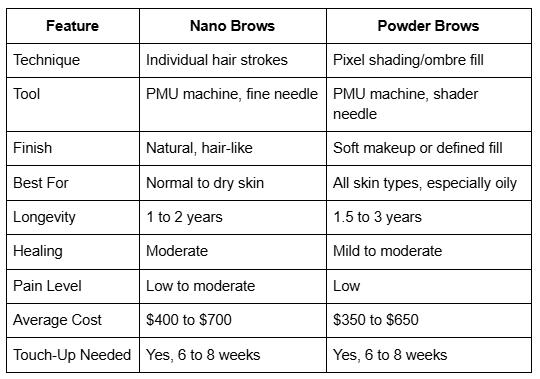
Nano brows use a single, ultra-fine needle that punctures the skin to draw individual strokes. Powder brows use a grouping of shader needles that deposit dots of pigment in layers.
Both use a digital PMU rotary machine. The machine itself is often identical; what differs is the needle configuration and the artist's hand motion and technique.
How Do the Appearance and Finish Differ?
Nano brows look like individual brow hairs. Up close, you can distinguish each stroke. The result is dimensional and natural-looking.
Powder brows look like the brow has been filled with eyebrow powder or pencil. The finish is smoother, softer, and more uniform. From a distance, both techniques can look similar, but up close, the difference is clear.
How Do Healing and Recovery Differ?
Both techniques involve the same general healing phases: initial darkness and mild swelling, followed by peeling and lightening, then gradual color return.
Nano brows can sometimes take slightly longer to fully settle because the fine strokes require the surrounding skin to heal without pulling the pigment. Powder brows tend to heal with a bit more consistency because the shading technique distributes pigment more evenly.
Expect the healing process to take 4 to 6 weeks for either technique before the final result is visible.
How Does Longevity Differ Between Nano and Powder Brows?
Powder brows generally retain pigment longer, averaging 1.5 to 3 years with proper aftercare. Nano brows typically last 1 to 2 years, though this varies by skin type, lifestyle, and sun exposure.
According to data shared across multiple PMU industry forums and artist surveys in 2024, oily skin clients saw up to 30% faster fading with nano brows compared to powder brows done on the same skin type.
How Do Maintenance and Touch-Ups Differ?
Both techniques require a touch-up appointment 6 to 8 weeks after the initial session. This is when the artist assesses pigment retention and corrects any light spots or uneven areas.
After that, annual or biannual color refreshes help maintain saturation. Nano brows may require touch-ups more frequently on skin types that cause the strokes to fade or blur faster.
How Do Pain Levels Compare?
Both techniques are performed with topical numbing cream applied before and during the procedure. Most clients describe the sensation as light scratching or vibration.
Powder brows tend to feel slightly less intense because the shading motion is gentler than the precise stroke work required for nano brows. Neither technique is typically described as severely painful by clients who have had proper numbing applied.
How Do Costs Compare?
In most markets, nano brows and powder brows are priced similarly, ranging from $350 to $700 for the initial session, including the 6 to 8-week touch-up. The exact cost depends on the artist's experience level, geographic location, and studio reputation.
Choosing a lower-priced artist to save money is one of the most common regrets in this industry, because corrections and removals cost significantly more than the original procedure. You will read more on that later.
Nano Brows vs Powder Brows for Different Skin Types
Skin type is arguably the single most important factor in determining which brow technique will serve you best. The same technique can look dramatically different on two people with different skin compositions.
What Is the Best Brow Option for Oily Skin?
Powder brows are the clear recommendation for oily skin. Excess oil disrupts how pigment settles in the skin and accelerates the fading of fine hair strokes.
When nano brows are applied to oily skin, the strokes can look sharp immediately after healing, but may begin to spread or blur within 6 to 12 months. Powder brows hold their shape more reliably because the shading technique is more resistant to the spreading effect caused by sebum.
What Is the Best Brow Option for Dry Skin?
Dry skin is where nano brows truly shine. The skin's lower sebum production allows hair strokes to stay crisp and defined for longer, and pigment tends to settle more evenly during healing.
If you have dry skin and want a natural, hair-mimicking result, nano brows are often the preferred choice among PMU artists. Powder brows also perform well on dry skin, but may not be necessary if your primary goal is a natural look.
What Is the Best Brow Option for Mature Skin?
Mature skin often has reduced elasticity and a thinner dermis. Both techniques can work, but powder brows are frequently recommended because the shading process is gentler and less likely to cause irregularities on skin that has lost firmness.
Nano brows require the skin to hold a fine stroke without it spreading or distorting. Mature skin sometimes makes this more difficult. Consult your artist specifically about your skin condition before committing to a technique.
How Do Large Pores Affect Brow Retention?
Large pores create an uneven skin surface that makes fine hair strokes difficult to maintain over time. Pigment deposited into a large pore sits in a wider channel, causing the stroke to appear thicker or blurrier than intended.
Powder brows are significantly more forgiving on large-pored skin because the shading technique does not rely on precise stroke edges. If your pores are visibly enlarged, discuss this with your artist during the consultation.
How Does Louisiana Humidity Impact Brow Results?
Louisiana's climate, including Lafayette's persistent heat and humidity, creates specific challenges for permanent makeup retention. High humidity accelerates sebum production in the skin, which can shorten the lifespan of nano brow hair strokes.
Clients in Lafayette and surrounding areas often find that powder brows hold up better through the warm, humid seasons. Your PMU artist should factor your local climate into their technique recommendation. This is one reason consulting a local artist with experience in this environment matters more than it might seem.
Nano Brows vs Powder Brows Healing and Aftercare
Understanding the healing process is just as important as choosing the right technique. Many clients are alarmed by what they see in the first week, only to fall in love with the final result six weeks later.
What Is the Week-by-Week Healing Timeline?
Days 1 to 3: The brows appear dark, bold, and slightly swollen. This is normal. The color will look more intense than the finished result.
Days 4 to 7: The surface begins to flake and peel. The brows may look patchy or uneven. Do not pick at the skin.
Week 2: Color lightens significantly, sometimes dramatically. Some areas may look nearly invisible.
Weeks 3 to 4: Color begins to return as the skin finishes surface healing.
Weeks 5 to 6: The true healed result emerges. This is when your touch-up appointment should be scheduled.
What Scabbing, Flaking, and Color Changes Are Normal?
Light flaking and some patchiness are normal and expected for both nano and powder brows. Heavy scabbing is less common but can occur if aftercare is neglected.
The temporary ghost phase, where brows appear extremely light or almost gone around week 2, is one of the most frequently misunderstood parts of the healing process. It does not mean the pigment failed. It means the surface skin is healing, and the deeper pigment has not yet revealed itself.
What Aftercare Mistakes Cause Premature Fading?
The following mistakes are the leading causes of poor pigment retention, according to PMU artist community reports and client case studies:
- Getting the brows wet in the first 7 to 10 days
- Applying too much ointment, which suffocates the healing skin
- Picking or peeling flaking skin instead of letting it shed naturally
- Using skincare products with acids, retinol, or exfoliants near the brow area
- Sun exposure without SPF protection during and after healing
- Sweating heavily during the first 10 days after intense exercise
How Do Touch-Ups Work?
The initial touch-up, scheduled 6 to 8 weeks after the procedure, is not optional. It is part of the process.
During this session, the artist examines how the pigment settled, identifies any light patches, and adds color or strokes as needed. No two clients heal identically, which is why touch-ups exist.
After the touch-up heals, you should enjoy your results for 1 to 3 years, depending on your skin type and aftercare habits.
What Factors Affect Pigment Retention?
- Skin type: Oily skin fades faster than dry or normal skin
- Sun exposure: UV light breaks down pigment over time
- Skincare routine: Products with acids or retinol accelerate fading
- Medications: Some medications, including blood thinners and certain acne treatments, affect retention
- Immune response: Some clients' bodies reject pigment more aggressively than others
- Artist skill: Pigment deposited at the wrong depth fades faster or heals patchily
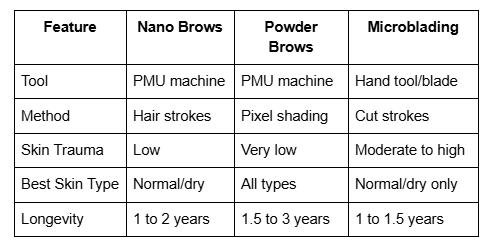
Nano Brows vs Powder Brows vs Microblading
You may be wondering where microblading fits into this picture. It is worth addressing directly because many people start their research there.
What Are the Key Differences Between All Three Techniques?
Ready to wake up with perfect brows every morning?
Book your appointment today at Symetrie Studio Spa and take the first step toward brows that are always ready.
Book Now
Book Into our Symetrie Studio Spa
Ready to take the next step? Book a consultation with a qualified permanent makeup artist.
Book Now