

Microneedling for Acne Scars: Does It Work?
- It is safe for all skin tones because it leaves the outer layer of skin intact.
- In Louisiana, microneedling sits outside the esthetician scope of practice. Ask who will perform your treatment, and under what license, before you book.
Quick Answer: Does Microneedling Work for Acne Scars?
Yes, for depressed scars, within limits worth understanding before you commit to a series.
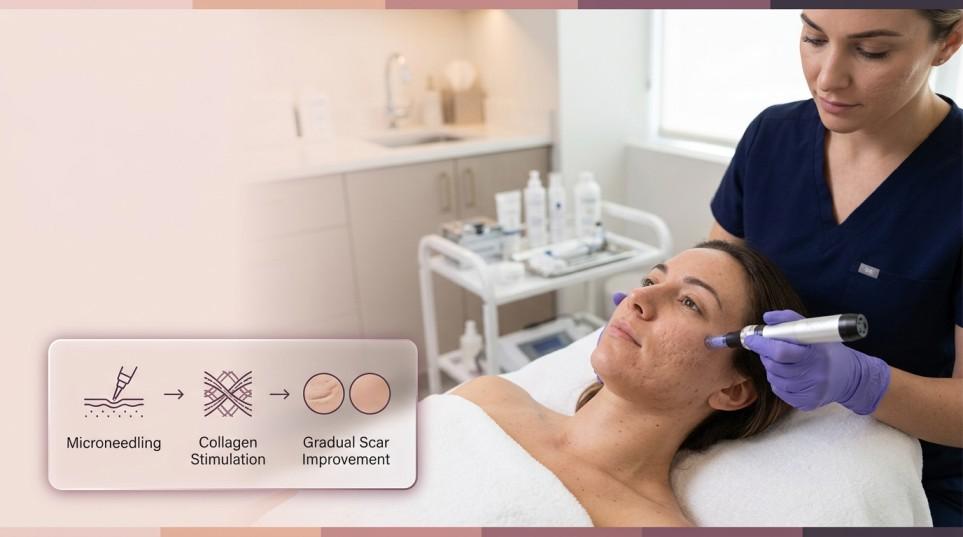
A microneedling pen creates thousands of controlled micro-injuries in the skin. Your body repairs them by producing new collagen, and that collagen gradually fills the deficit under a depressed scar. The floor of the scar rises, the walls become less abrupt, and the scar catches less shadow in angled light. Because the outer layer of skin is punctured rather than removed, downtime stays short, and pigmentation risk stays low.
Can Microneedling Completely Remove Acne Scars?
No. Nothing currently available removes atrophic acne scars completely, and any provider who suggests otherwise is describing marketing rather than wound healing. What changes is how visible the scar is at conversational distance and how well makeup sits over it. Setting that expectation early is the difference between being pleased with a 60 percent improvement and being disappointed by it.
How Long Do Results Last?
The collagen your skin builds is real structural tissue, so the improvement is not temporary the way a filler is. According to the AAD, results fade as your body loses collagen with age. Sun protection and not smoking slow that loss, and a maintenance session roughly once a year is common. The bigger risk is new breakouts, since no amount of past microneedling prevents new scars.
How Effective Is Microneedling for Acne Scars?
A systematic review of randomized controlled trials in the International Wound Journal concluded that microneedling is effective for atrophic acne scars, both on its own and combined with other treatments, with no serious adverse effects across the included trials. A separate meta-analysis of 12 randomized trials covering 414 participants reached a similar conclusion.
Two caveats matter. Sample sizes are small, studies use different scar grading scales, and few trials compare microneedling head-to-head with other options over the long term. The evidence supports microneedling as a reasonable choice, not as the best choice for every person.
How Much Improvement Is Realistic?
The most commonly cited figure comes from the AAD: three to five treatments performed every two to four weeks can fade acne scars by 50 to 70 percent. Treat that as a range, not a promise. Where you land inside it depends on how deep your scars are, which types you have, how your skin heals, and whether your acne is currently under control. Shallow, broad depressions can improve dramatically. Deep, sharply walled scars improve less with the same number of sessions.
Which Acne Scars Respond Best to Microneedling?
First, Make Sure You Have Scars and Not Marks
Flat red, purple, or brown spots left behind after a breakout are pigment and blood vessel changes, not scars, and most fade on their own within a year with consistent sun protection. A simple test: stretch the skin gently. Marks stay flat and even. True scars show a depression or an edge that stays visible when the skin is taut. If discoloration is your main concern, a treatment aimed at pigment will get you further than one aimed at texture.
Depressed scars, called atrophic scars, are what microneedling treats. They come in three shapes, and most people have a mix of them.
Rolling Scars: Strong Candidates
Broad, shallow depressions with sloping edges that create a wavy look in side lighting. Reviews comparing microneedling across scar types consistently find the greatest improvement here. One qualifier: rolling scars are tethered to deeper tissue by fibrous bands, and microneedling does not release those bands. Deeply tethered scars often improve more when subcision is performed first, and microneedling follows.
Boxcar Scars: Good to Partial
Wider depressions with steep, clearly defined walls, like small craters. Shallow boxcar scars respond well, because the added collagen raises the floor of the scar and softens the edge that casts the shadow. Deep boxcar scars with sharply defined walls can be softened but are rarely resolved by microneedling alone, and these are the ones most likely to need a resurfacing or surgical technique alongside it.
Icepick Scars: Limited Response
Narrow, deep pits that taper to a point, most often on the cheeks and temples. A microneedling pen cannot reliably reach the base of a tract that narrow, so the collagen it stimulates is deposited around the scar rather than under it. Published reviews identify TCA CROSS, which applies high-strength trichloroacetic acid focally into the base of individual scars, as the more consistent option, with punch excision used for the deepest ones. If icepick scars are your main concern, a dermatology consultation is the better starting point.
Raised and Keloid Scars: Not Suitable
Raised scars already contain too much collagen, so stimulating more can make them more prominent. For anyone with a keloid tendency, the concern goes further, since controlled injury can trigger new keloid formation. That is why the AAD's guidance is to avoid microneedling entirely rather than to proceed carefully. Raised acne scars are usually managed with intralesional steroid injections, which is a conversation for a dermatologist.
Is Microneedling Right for Your Acne Scars?
Use your scar type as the starting point:
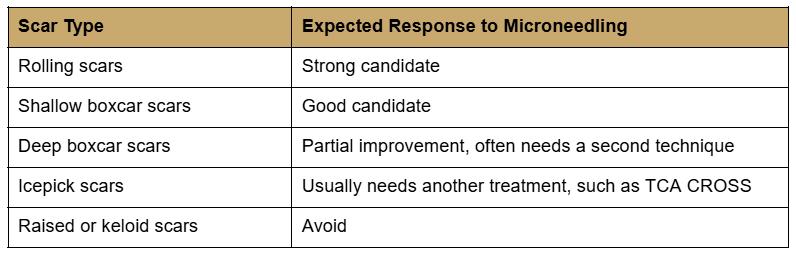
Two other things decide this alongside scar shape. Your acne needs to be controlled first, because treating scars while new ones are forming means paying for a moving target. And your skin needs to be clear of active infection, recent sun exposure, and isotretinoin within the past month.
If you are not sure which scars you have, that is exactly what a consultation is for. Symetrie Studio Spa offers complimentary consultations on all services, and an honest assessment of which scars will and will not respond is worth more than any single session you could book today.
Book Into our Symetrie Studio Spa
Ready to take the next step? Book a consultation with a qualified permanent makeup artist.
Book Now
How Many Microneedling Sessions Are Needed?
For acne scarring, the AAD describes a course of three to five treatments. Deeper or more extensive scarring often requires the upper end of that range or more, and mixed scarring may require additional procedures alongside it. Be cautious about any plan built around a single session, since meaningful scar change is cumulative rather than immediate.
Sessions are typically spaced two to four weeks apart so the skin can complete one healing cycle before the next round of controlled injury. Shorter intervals do not accelerate collagen production, and they increase the risk of irritation and pigmentation changes. If a provider suggests weekly sessions for acne scarring, ask them to explain the reasoning.
When Will You See Results?
Collagen synthesis and remodeling are slow biological processes. Your skin lays down new collagen over weeks, then spends months maturing it into functional tissue, which is why judging your outcome too early is the most common reason people abandon a plan that was working.
- Days 1 to 7: redness and mild swelling settle. Skin feels tight and may flake. Nothing about your scars has changed yet.
- Weeks 2 to 6: texture and tone improve first. Skin looks smoother and more even before the scars themselves visibly change.
- Months 3 to 6: the meaningful scar improvement appears, typically after a full series is complete.
Recovery, Side Effects, and Safety
What a Session Involves
Your skin is cleansed, and numbing cream is applied for roughly 20 to 30 minutes. The provider then passes the pen across the area in overlapping directions, adjusting needle depth by facial zone, since thicker cheek skin tolerates more depth than skin near the eyes or jaw. Expect pinpoint redness and, in deeper areas, small amounts of pinpoint bleeding. Both are normal. Most people describe a scratching or vibrating sensation rather than pain. Plan on about an hour for a full face, most of it numbing time.
How to Prepare
The AAD notes that following a simple, consistent skin care routine for two to four weeks beforehand improves your response. Before your appointment:
- Stop retinoids, acids, and exfoliating scrubs a few days ahead.
- Avoid sun exposure and tanning. Treatment is deferred if you have a tan or a sunburn.
- Wait at least one month after your last isotretinoin (Accutane) pill.
- Let any active infection clear, including cold sores. Mention a history of cold sores, since preventive antiviral medication is sometimes prescribed.
- Disclose blood thinners and supplements that affect clotting rather than stopping anything on your own.
- Get painful, pus-filled, or deep pimples treated first. Needling across an inflamed lesion can spread bacteria and provoke further inflammation.
Recovery and Aftercare
Expect redness on lighter skin tones or a darker flush on deeper tones, a moderate sunburn sensation, and mild swelling on the first night. Skin often feels tight and flakes lightly afterward. According to the AAD, these reactions usually resolve within a few days to a week, and most redness fades within 24 to 48 hours. Deeper treatments for acne scarring sit at the longer end, so book at least a week before any event.
- Cleanse gently with a fragrance-free cleanser and lukewarm water, and moisturize often.
- Use broad-spectrum SPF 50 daily once your provider clears sunscreen, and avoid direct sun for about a week.
- Skip makeup for 24 hours, and retinol and acids for about a week.
- Avoid heavy exercise, sweating, saunas, hot water, and chlorinated pools for 24 to 48 hours.
- Let flaking skin shed on its own rather than picking at it.
Side Effects and Risks
Most side effects are short-lived: redness, mild swelling, tenderness, dryness, flaking, and pinpoint bleeding. Less common but more serious risks include infection, prolonged discoloration, and scarring. The FDA notes that while most side effects resolve shortly after treatment, some can be long-lasting and a small number are permanent. It is a low-risk procedure, not a no-risk one.
Microneedling can make scarring worse in three predictable situations: treating someone with a keloid tendency, needling over active acne or infection, and using excessive depth or pressure. The AAD is clear that when microneedling is performed by someone without medical training, the risk of infection, scarring, and long-lasting discoloration goes up. A temporary acne flare in the first week or two is usually transient, but tell your provider if it happens.
Who Should Avoid Microneedling
The AAD lists the following as reasons not to have microneedling:
- A history of keloid scarring
- Slow or poor wound healing
- A weakened immune system, whether from a medical condition or medication
- Current treatment for skin cancer in the area you want treated
- Ongoing radiation treatment
Is Microneedling Safe for Darker Skin Tones?
Yes. The AAD states that microneedling is safe for all skin tones, and the reason is mechanical: the treatment punctures the epidermis rather than removing or heating it away, which avoids the mechanism that drives pigmentation problems in ablative resurfacing. Because Fitzpatrick skin types IV to VI carry a higher risk of post-inflammatory hyperpigmentation from heat-based treatments, microneedling is frequently the preferred starting point for deeper skin tones.
The risk is lower, not zero. Treating skin that is currently tanned, treating active inflammation, and inadequate sun protection afterward all raise it, and all three are controllable, which is why the preparation and aftercare rules above are not optional formalities.
Professional vs. At-Home Microneedling
These are different categories of product, not the same treatment at different intensities. The FDA has authorized professional microneedling devices as Class II medical devices that require a licensed healthcare provider to operate, and no microneedling device has been authorized for over-the-counter sale. The first, the SkinPen Precision System, was cleared in 2018 specifically for facial acne scars in adults aged 22 and over.
Consumer rollers are built not to penetrate the skin the way a professional device does. As the AAD puts it, products sold for at-home microneedling are not meant to puncture the skin, and these gentler products produce less noticeable results. The AAD also flags four hazards: overuse, accidental penetration, spreading warts and herpes with a device that is difficult to sterilize, and pressing too hard.
For acne scarring, there is an extra problem: the depth needed to influence dermal scar tissue is not achievable with a consumer device, so even used perfectly, a home roller is unlikely to change scar depth. A professional can identify which scars will respond, adjust depth by facial zone, use a single-use sterile cartridge, and recognize when microneedling is the wrong tool entirely.
Microneedling vs. Other Acne Scar Treatments
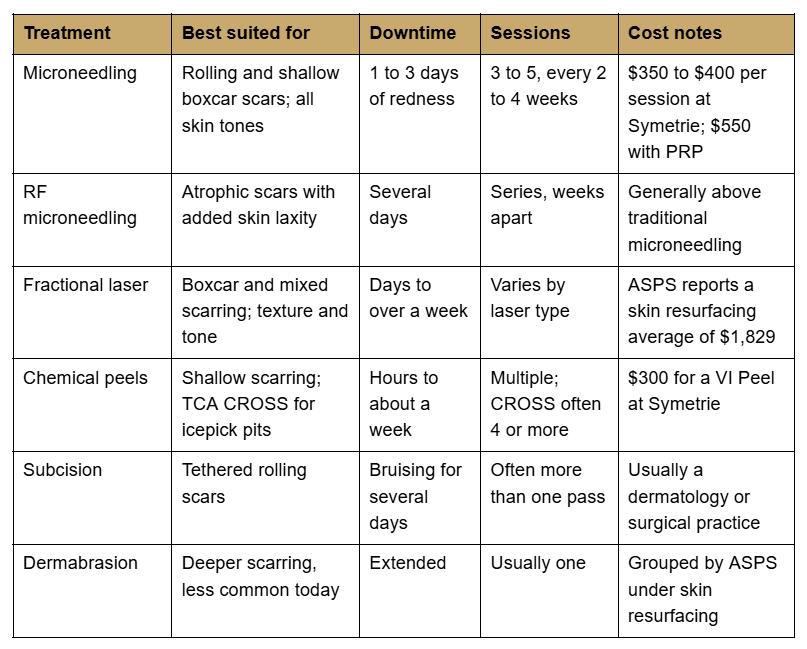
Head-to-head trials are scarce, and downtime varies with how aggressively a treatment is performed, so treat the table below as general orientation rather than a substitute for assessment.
Microneedling vs. Laser Resurfacing
The trade-off is intensity against recovery and pigment risk. Ablative lasers remove the outer layer of skin, producing more dramatic resurfacing in fewer sessions with more downtime. The evidence gives no clean winner: one split-face study found an Er:YAG laser produced a higher scar response than microneedling while still finding microneedling effective. Skin tone, workable downtime, scar depth, and budget usually decide it, and for deeper skin tones microneedling's lower pigmentation risk is a real advantage.
Microneedling vs. Chemical Peels
These are tools for different depths rather than true alternatives. Superficial peels act on the epidermis and upper dermis, which suits shallow scarring and uneven tone but does little for established depressions. TCA CROSS is a different technique entirely, applying concentrated acid focally into individual scars, and it remains the more consistent option for icepick pits. One network meta-analysis found microneedling combined with chemical peels performed best among the combinations examined, though that came from an indirect comparison rather than a direct trial.
Microneedling vs. Subcision
Subcision does something microneedling cannot. A needle or cannula is passed under the scar to cut the fibrous bands tethering it to deeper tissue, which allows the depressed area to lift. It is the standard approach for tethered rolling scars and largely ineffective for icepick and boxcar scars, which lack that tethering. The two are usually sequenced rather than chosen between: release the tethers first, then remodel with microneedling.
When Combination Treatments Make Sense
Because most people have more than one scar type, combination approaches are standard dermatology rather than an upsell, and reviews consistently find they outperform microneedling alone. The usual sequence is to release tethered scars, remodel the dermis with microneedling, treat resistant pits with focal techniques, then address any remaining pigment. Spread across months, that is a longer commitment than a single series, which is why it deserves an honest conversation at the consultation stage.
Book Into our Symetrie Studio Spa
Ready to take the next step? Book a consultation with a qualified permanent makeup artist.
Book Now
Book Into our Symetrie Studio Spa
Ready to take the next step? Book a consultation with a qualified permanent makeup artist.
Book Now