

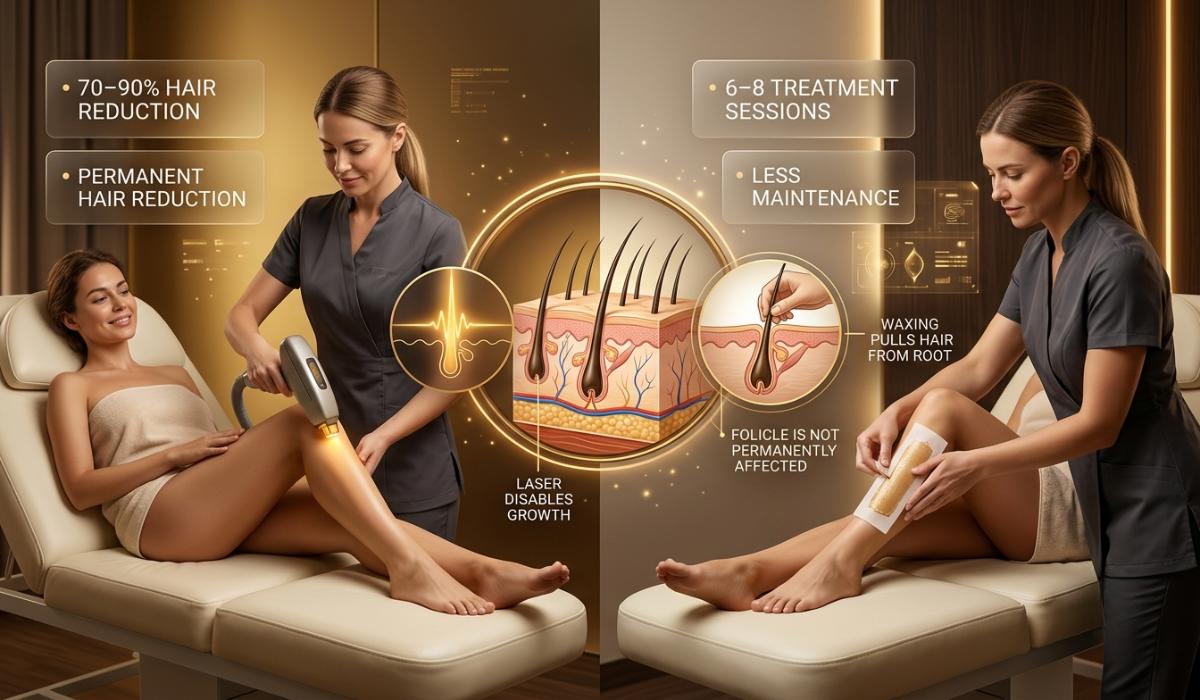
Laser Hair Removal vs. Waxing: Long-Term Comparison
I have worked with many clients at Symetrie Studio Spa who started exactly where you are now. Most walked in tired of the monthly grind. They wanted a treatment that slows hair down instead of just pulling it out. That treatment is laser hair removal.
In this guide, you will see how laser hair removal and waxing compare on results, cost, pain, and long-term value. By the end, you will know which method fits your hair, your skin, and your budget.
Laser Hair Removal vs. Waxing: Quick Comparison
Key Takeaways
- Laser targets the hair follicle with heat; waxing pulls hair out at the root.
- Laser needs 6 to 8 sessions upfront, then rare touch-ups.
- Waxing needs a new appointment every 3 to 4 weeks, forever.
Key Differences at a Glance
Here is the short version before we go deeper. This table gives you the core facts side by side.
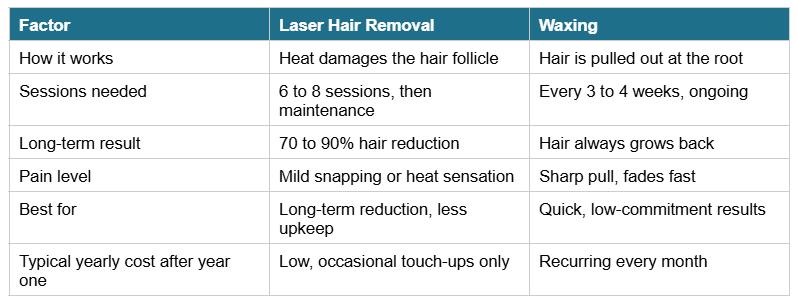
Which Option Is Better for Long-Term Results?
Laser hair removal wins for long-term results. Waxing never changes the hair follicle itself. It just removes the hair that is already there. Laser damages the follicle so it produces thinner, sparser hair over time.
That said, waxing still has a place. If you want quick results before a single event with no upfront commitment, waxing works. But if you are tired of the cycle, laser is built for exactly that problem.
Understanding Hair Growth and Why It Matters
Key Takeaways
- Hair grows in three phases: anagen, catagen, and telogen.
- A laser only works on hair in the active growth phase.
- This is why a laser needs multiple sessions, spaced weeks apart.
How the Hair Growth Cycle Works
Hair growth cycle: the three-stage process every hair follicle moves through on repeat. Anagen is the active growth stage. Catagen is a short transition. Telogen is the resting stage, right before the hair sheds.
At any given time, only about 10 to 20 percent of your hair sits in the anagen phase. The rest are resting or transitioning. This detail explains almost everything about how these two treatments differ.
Why Multiple Laser Sessions Are Necessary (vs. Waxing's Repeat Cycle)
Laser energy only damages hair that is actively growing. That is why a single session cannot catch every follicle. According to the American Academy of Dermatology, one session reduces regrowth by roughly 10 to 25 percent.
As more follicles cycle into the anagen phase, later sessions catch them too. After 6 to 8 sessions spaced 4 to 8 weeks apart, most clients reach a 70 to 90 percent reduction.
Waxing works differently. It does not care what phase the hair is in. It just pulls out whatever hair exists that day, whether it is a day-old or three-week-old hair.
How Each Method Works
Key Takeaways
- Laser uses targeted light energy to heat and damage the follicle.
- Waxing physically pulls the hair from the root.
- Only lasers change future hair growth. Waxing does not.
How Laser Hair Removal Targets Follicles
Laser hair removal: a treatment that uses concentrated light to heat and damage the hair follicle. The light targets melanin, the pigment in your hair. That pigment absorbs the light and converts it into heat.
The heat travels down into the follicle and disables it. A disabled follicle either stops producing hair or produces thinner, lighter hair going forward. This is why results improve session after session.
How Waxing Removes Hair from the Root
Waxing: a method that applies warm wax to the skin, then removes it with the hair attached. The wax grips the hair shaft and pulls the entire strand out, root and all.
Because the follicle itself is untouched, it starts growing a new hair almost right away. Most people notice regrowth within three to four weeks.
Why Regrowth Differs Between the Two
Waxing regrowth comes back at full strength every time. The follicle was never damaged, so nothing changes long-term. Laser regrowth is different. Each session leaves more follicles inactive.
Over a full series, the hair that does return is usually finer and lighter. Many clients describe it as barely noticeable compared to their original hair.
Book Into our Symetrie Studio Spa
Ready to take the next step? Book a consultation with a qualified permanent makeup artist.
Book Now
Laser Hair Removal vs. Waxing: Side-by-Side Comparison
Key Takeaways
- Laser wins on long-term effectiveness, regrowth, and ingrown hair prevention.
- Waxing wins on upfront cost and zero downtime.
- Both cause similar, mild, short-term skin reactions.
Long-Term Effectiveness and Permanence
Laser hair removal is not marketed as permanent removal. The FDA clears laser devices for "permanent hair reduction," a long-term drop in regrowth, not full elimination. Electrolysis is the only method the FDA recognizes for permanent removal.
Still, a 70 to 90 percent reduction after a full series is a dramatic, lasting change. Waxing offers zero long-term change to the follicle, no matter how many years you keep doing it.
Hair Regrowth
- Laser: thinner, sparser, lighter regrowth after each session
- Waxing: full-strength regrowth every single time
- Laser: occasional maintenance sessions, once or twice a year
- Waxing: a fresh appointment every 3 to 4 weeks, indefinitely
Treatment Time and Frequency
A laser session on a small area, like the underarms, takes about 15 to 20 minutes. Larger areas, like the legs, can take 45 to 60 minutes. Sessions are spaced 4 to 8 weeks apart for 6 to 8 total treatments.
Waxing appointments run shorter, often 15 to 45 minutes, depending on the area. The catch is you repeat that appointment every month, for as long as you want smooth skin.
Pain and Comfort (brief)
Laser hair removal feels like a warm snap against the skin, similar to a rubber band flick. Waxing involves a sharp, quick pull that fades within seconds. Most clients find laser more tolerable session after session, since sensitivity often drops as hair thins.
Recovery Time
Laser hair removal has little to no downtime. Mild redness usually fades within a few hours. Waxing can leave temporary redness or sensitivity for a day, especially on sensitive areas like the bikini line.
Hair Color and Skin Tone Compatibility
Laser works best on dark, coarse hair with lighter skin, since the laser targets pigment in the hair. Modern devices, like the Nd: YAG laser, safely treat darker skin tones too. Blonde, gray, red, and white hair respond poorly to laser.
Waxing works on any hair color and any skin tone. This is one of its real advantages if your hair lacks pigment.
Ingrown Hair Prevention
Waxing can cause ingrown hairs, especially as new hair grows back at an angle. Laser hair removal reduces this risk over time, since fewer active follicles mean fewer chances for hair to curl back into the skin.
Long-Term Cost Comparison
Key Takeaways
- Waxing costs the same, or more, every single year, forever.
- Laser has a higher upfront cost but drops sharply after year one.
- Over 10 years, lasers have been the cheaper option for most areas.
Upfront Cost vs. Long-Term Investment
Waxing looks cheaper per visit. But that low price repeats every 3 to 4 weeks, for as many years as you want the results. Laser costs more upfront because you are paying for a full series of 6 to 8 sessions.
After that series, most clients only need one or two touch-up sessions a year. That is where the real savings show up.
One-Year Cost Comparison
Here is an example using underarm hair removal, a common starting area. Exact pricing varies by provider and treatment area.

Five-Year Cost Comparison

Ten-Year Cost Comparison

Which Option Offers Better Long-Term Value?
The math is clear for anyone planning to remove hair from the same area for years. Laser hair removal costs more upfront but far less over time. Waxing only makes sense if you want a short-term or occasional solution.
Side Effects and Safety
Key Takeaways
- Both methods cause mild, temporary redness in most people.
- Laser carries a small risk of pigment change on unprotected, tanned skin.
- Waxing carries a higher risk of ingrown hairs and irritation.
- A trained provider and good aftercare lower risks for both.
Common Side Effects of Laser Hair Removal
- Mild redness and swelling, similar to a light sunburn
- Temporary lightening or darkening of the skin
- Rare burns or blisters from improper settings
- Rare infection if aftercare instructions are ignored
Common Side Effects of Waxing
- Redness and mild sensitivity right after the pull
- Ingrown hairs, especially on the bikini line and legs
- Occasional skin lifting on sensitive or thin skin
- Breakouts in areas prone to clogged pores
How to Reduce Treatment Risks
Choose a licensed, experienced provider for either treatment. Avoid sun exposure before and after laser sessions. For waxing, exfoliate a day or two beforehand and avoid tight clothing right after your appointment.
Book Into our Symetrie Studio Spa
Ready to take the next step? Book a consultation with a qualified permanent makeup artist.
Book Now
Book Into our Symetrie Studio Spa
Ready to take the next step? Book a consultation with a qualified permanent makeup artist.
Book Now