How Many Laser Hair Removal Sessions Do You Need?
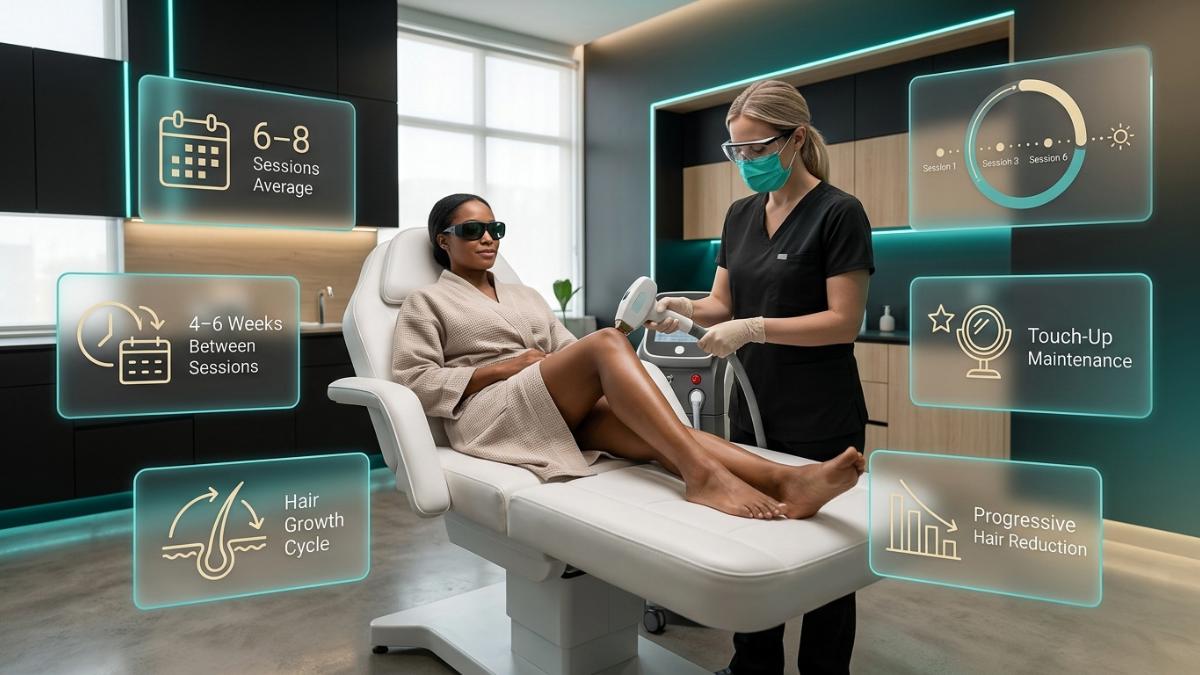
Most people need 6 to 8 laser hair removal sessions spaced 4 to 6 weeks apart. The American Academy of Dermatology says most patients need 2 to 6 treatments. A full plan often spans 6 to 18 months, depending on your hair and treatment area.
Key Takeaways
- Most patients complete their plan in 6 to 8 sessions, spaced 4 to 6 weeks apart.
- Hormonal areas like the chin, bikini line, and underarms often need more sessions than the arms or legs.
- Hair color, skin tone, and conditions like PCOS can add 2 to 4 extra sessions.
- The FDA classifies laser hair removal as permanent hair reduction, not permanent removal, so occasional touch-ups matter.
- Sticking to your session schedule, rather than spacing appointments out, shortens your total treatment time.
You want smooth, hair-free skin, but you are not sure how many appointments that actually takes. Maybe you already had one session, and the hair grew back. This is normal. Laser hair removal works in stages, not a single visit.
At Symetrie Studio Spa in Youngsville, we hear this question every week. Your hair grows in cycles, and each cycle affects when laser energy can reach the follicle. Understanding this cycle is the key to a realistic timeline.
Recent Post
In this guide, you will learn the average number of sessions for your treatment area. You will also learn what affects your personal timeline, from hair color to hormones. By the end, you will know exactly what to expect from your laser hair removal sessions.
How Many Laser Hair Removal Sessions Do Most People Need?
The Average Number of Sessions
Most people complete their plan in six to eight sessions. According to the American Academy of Dermatology, most patients need two to six laser treatments to remove hair. Many med spas, including ours, still recommend six to eight sessions for longer-lasting reduction, since hair grows back over several cycles.
Your personal number depends on your hair color, hormones, and treatment area. Coarse chin hair, for example, often needs more sessions than fine hair on the arms. As a result, your technician builds a plan around your specific hair pattern, not a generic number.
How Long the Complete Treatment Plan Takes
A full treatment plan usually takes six months to about a year. Sessions must be spaced weeks apart to catch hair in its active growth phase. Larger areas, like the legs or back, may take closer to a year.
Smaller areas, such as the upper lip, often finish faster. Some clients see visible results within the first three sessions, though full results take the entire plan. Skipping sessions can extend this timeline.
How Far Apart Sessions Should Be Scheduled
Most sessions are scheduled four to six weeks apart. This spacing lets new hairs enter their active growth phase before your next visit. The American Academy of Dermatology confirms most patients can have laser hair removal once every four to six weeks.
Facial areas may need appointments closer together, around four weeks. Larger areas, like the legs, often work well on a six-week schedule. Sticking to this schedule keeps your plan on track.
Why Multiple Sessions Are Necessary
How Laser Energy Targets Hair Follicles
Laser energy works by targeting melanin, the pigment inside your hair. The laser heats this pigment, which damages the follicle underneath. This disables the follicle's ability to grow new hair.
However, the laser only affects follicles that are actively growing at that moment. Resting or shedding follicles are untouched during that visit. This is why one session cannot reach every hair on your body.
Understanding the Hair Growth Cycle
Every hair on your body cycles through three phases. Each phase determines whether laser treatment can affect that specific hair.
- Anagen phase: The active growth phase, when hair is attached to a blood supply and full of pigment. Laser treatment works best here.
- Catagen phase: A short transition phase lasting a few weeks. Hair becomes less responsive to laser energy during this stage.
- Telogen phase: The resting phase, when the follicle is dormant. Laser energy has little effect during telogen.
At any given time, your follicles sit in different phases. This staggered pattern is exactly why your plan requires several sessions over time.
Why One Session Cannot Remove Every Hair
A single session can only treat hairs currently in anagen. Since follicles cycle independently, many hairs sit in catagen or telogen during any one visit.
The American Academy of Dermatology reports a 10% to 25% reduction in hair after the first treatment. This is a normal, expected result. Repeat sessions target the hairs that were resting during earlier visits.
What Happens After Your First Session
You may notice hairs falling out within one to two weeks after your first session. This shedding is a normal sign the follicle was treated. Some hair will also regrow, since not every follicle was active.
Do not expect complete smoothness after one visit. Instead, look for gradual thinning over the following weeks. Each session builds on the last one.
How Many Sessions Are Needed by Treatment Area?
Face and Upper Lip
The face and upper lip typically need six to eight sessions. Facial hair grows in a shorter cycle, so sessions here are often spaced four weeks apart. Fine, light colored upper lip hair can need extra sessions.
Hormonal changes can also extend this area's timeline. Your technician may recommend occasional touch-ups even after your plan ends.
Chin and Neck
The chin and neck often need eight to ten sessions, especially with hormonal hair growth. This area responds more slowly than areas like the underarms, since chin hair is frequently coarser.
Because chin hair can be stubborn, staying consistent with your schedule matters even more here.
Underarms
Underarms usually respond well, needing about six to eight sessions. Hair here is often coarse and dark, which absorbs laser energy efficiently. Many clients see noticeable thinning by the fourth session.
Since underarm hair grows in a short cycle, sessions are typically spaced four to six weeks apart.
Arms
Arms generally need six to eight sessions for lasting reduction. Arm hair varies in thickness from person to person, so your count may shift slightly. Fine, light forearm hair can take a few extra sessions.
Larger surface area also means each session takes a bit longer than smaller zones.
Bikini Line and Brazilian
The bikini line and Brazilian area typically need six to eight sessions, sometimes up to ten. Hair here is often coarse, but density varies widely between clients.
Because this is a sensitive area, following your pre-treatment and aftercare instructions closely matters for comfort and results.
Book Into our Symetrie Studio Spa
Ready to take the next step? Book a consultation with a qualified permanent makeup artist.
Book Now
Legs
Legs usually require six to eight sessions for full-leg treatment. Since this is a large area, sessions may be spaced closer to six weeks apart. Many clients notice a real reduction by session five or six.
Lower legs sometimes respond faster than upper thighs, due to hair density differences.
Chest and Abdomen
Chest and abdomen hair, often coarser and hormonally influenced, typically needs six to eight sessions. Men frequently see strong results here, since this hair tends to be dense and dark.
As with other large areas, consistent spacing between sessions supports faster, more even results.
Back and Shoulders
Back and shoulder hair usually needs six to eight sessions as well. This area is hard to reach for shaving, so many clients prioritize it early. Hair density here varies significantly between clients.
Because the back is a larger surface, sessions may run longer than smaller areas.
What Factors Affect the Number of Sessions You Need?
Hair Color and Thickness
Dark, coarse hair responds best to laser treatment, since it holds the most pigment. Lighter hair, including blonde, red, gray, or white hair, contains far less pigment.
As a result, these hair colors often need more sessions, or may not respond well at all. Coarse, dark underarm hair often clears faster than fine arm hair.
Skin Tone and Fitzpatrick Skin Type
Your skin tone is measured using the Fitzpatrick scale, ranging from type I to type VI. Lighter skin tones, types I through III, often respond quickly to most laser devices.
Darker skin absorbs more pigment overall. Treatment may need careful laser settings and sometimes one or two extra sessions. Your provider should always match the laser type to your skin tone.
Hormonal Conditions and PCOS
Hormonal conditions can significantly affect how many sessions you need. Hirsutism, or excess hair growth, affects an estimated 5% to 10% of women, according to the Endocrine Society. Polycystic ovary syndrome, or PCOS, is the most common cause of elevated androgen levels behind this pattern.
Hormonal hair growth can keep producing new hair. As a result, clients with PCOS often need extra sessions and more frequent maintenance later.
Medications That Affect Hair Growth
Certain medications can stimulate new hair growth or change how existing hair responds to treatment. Hormonal medications, some steroids, and specific supplements fall into this category.
Always share your current medication list with your provider before starting treatment. This helps your technician plan a more accurate schedule.
Sex and Gender Differences
Men often need more sessions than women in areas like the chest, back, and neck. This is due to naturally coarser, denser hair growth in these zones.
Women, meanwhile, may need more sessions on hormonally sensitive areas, such as the chin, when hormonal hair growth is present.
Treatment Area Size
Larger areas, like the full back or both legs, naturally take more time per session. However, size alone does not always mean more total sessions.
A large area with fine, sparse hair may need fewer sessions than a smaller area with coarse, dense hair.
Hair Growth Patterns
Some people have hair that grows in unpredictable cycles, rather than a consistent pattern. This can happen due to genetics, hormones, or previous methods like waxing or plucking.
Your provider will track your progress across sessions and adjust your plan as your pattern becomes clearer.
What to Expect During Each Session
Each session typically takes 15 minutes to over an hour, depending on the area. Small areas, like the upper lip, finish quickly. Larger areas, like the back or legs, take longer.
You may notice shedding of treated hair within one to two weeks. This is a normal part of the process, not new growth.
Most clients feel a mild snapping sensation during treatment, though discomfort varies by area and pain tolerance. Aftercare also plays a role in your results.
What Results Can You Expect Throughout Your Treatment Plan?
Results After the First Session
After your first session, expect a 10% to 25% reduction in hair. This is a normal starting point, not a final result. Many clients also notice shedding within the first two weeks.
Results at this stage vary by hair color, thickness, and area. Patience here sets realistic expectations for the sessions ahead.
Progress After Three to Four Sessions
By session three or four, hair should look noticeably thinner and grow back more slowly. Many clients start shaving less often around this point.
Hair that does regrow is often lighter and finer than before. Staying consistent with your schedule matters most during this middle phase.
Results After Completing the Recommended Sessions
After completing your recommended sessions, most clients see significant, long-lasting hair reduction. Any regrowth is typically lighter, finer, and far less noticeable.
At this stage, many clients move to occasional maintenance sessions, rather than a regular treatment schedule.
Is Laser Hair Removal Permanent? Understanding Maintenance Sessions
Permanent Hair Reduction vs. Permanent Hair Removal
The FDA classifies laser hair removal as permanent hair reduction, not permanent hair removal. Permanent hair reduction is defined as the long-term, stable reduction in the number of hairs regrowing when measured at 6, 9, and 12 months after treatment.
Electrolysis is currently the only method the FDA recognizes for full permanent removal. Laser hair removal remains the more practical option for larger areas, despite this technical distinction.
Why Some Hair Can Grow Back
A small percentage of follicles resist laser damage. Hormonal changes, pregnancy, and certain medications can also trigger new hair growth over time.
This regrowth is usually lighter, finer, and less dense than before treatment because follicles can occasionally reactivate; some regrowth after your plan is expected.
How Often Touch-Up Treatments Are Needed
Most clients need touch-ups once or twice a year after completing their initial plan. This keeps results consistent as follicles occasionally reactivate.
Your technician can recommend a personalized maintenance schedule based on how your skin responded to your original sessions.
Who May Need More Frequent Maintenance
Clients with PCOS or other hormonal conditions often need more frequent maintenance. Pregnancy and certain medications can also increase how often touch-ups are needed.
If you notice faster regrowth than expected, schedule a consultation to adjust your maintenance plan.
Book Into our Symetrie Studio Spa
Ready to take the next step? Book a consultation with a qualified permanent makeup artist.
Book Now
How to Get the Best Results From Your Treatment Plan
Stick to the Recommended Treatment Schedule
Sticking to your schedule is the single biggest factor in finishing on time. Skipping or delaying sessions lets more hair cycle back into a resting phase.
If you need to reschedule, try to stay close to your original appointment window.
Never Wax or Tweeze Between Sessions
Waxing and tweezing remove the hair root, which laser treatment needs to target. Doing either between sessions can undo your progress and add extra sessions.
Shaving is safe between visits. If you are unsure what is safe, ask your technician first.
Protect Your Skin From Sun Exposure
Sun exposure can make your skin more sensitive to treatment and raise your risk of side effects. Tanned skin also absorbs more laser energy, which can affect safety and results.
Always apply sunscreen to treatment areas between sessions. Avoiding tanning beds during your plan matters just as much.
Follow Pre-Treatment and Aftercare Instructions
Following pre-treatment steps, like avoiding sun exposure and shaving beforehand, helps your session run smoothly. Aftercare steps, like avoiding hot showers and heavy exercise, help your skin recover properly.
At Symetrie Studio Spa, we walk every client through these steps before and after each visit.
Conclusion
Most people need six to eight laser hair removal sessions to see lasting results, though your exact number depends on your hair, skin, and treatment area. Hormonal conditions, medications, and hair color all play a role in your personal timeline. Sticking to your recommended schedule remains the most important factor in finishing on time.
Understanding your hair growth cycle helps explain why one session is never enough. Each phase- anagen, catagen, and telogen- determines whether laser energy can reach a specific hair at that moment. This is exactly why a full treatment plan spans several months, not a single visit.
At Symetrie Studio Spa, we build a personalized treatment plan around your hair, skin, and goals. Our team in Youngsville has helped many clients move from daily shaving to lasting smoothness. We invite you to book a free consultation and find out exactly how many sessions your treatment area needs.
FAQ
How many laser hair removal sessions do I need for the legs?
Most clients need six to eight sessions for full-leg treatment. Sessions are typically spaced about six weeks apart, since legs are a larger area. Hair density and color also affect your exact number. Your technician can give a personalized estimate at your first visit.
Can I do laser hair removal if I have PCOS?
Yes, laser hair removal can still work well with PCOS, though you may need extra sessions. Hormonal hair growth can continue producing new hair during treatment. Many clients with PCOS also benefit from more frequent maintenance visits afterward. A consultation helps set realistic expectations.
Is laser hair removal permanent after 6 sessions?
Not always. The FDA classifies laser hair removal as permanent hair reduction, not permanent removal. Most clients see significant, long-lasting results after six to eight sessions, though some regrowth is possible. Occasional touch-up sessions typically keep results consistent over time.
What happens if I miss a laser hair removal session?
Missing a session can extend your overall treatment plan, since your schedule follows your hair's growth cycle. Try to reschedule as close to your original appointment as possible. Waiting too long between sessions may let previously treated hair regrow.
Does hair color affect how many sessions I need?
Yes. Dark, coarse hair responds best to laser treatment and often needs fewer sessions. Light hair, including blonde, red, gray, or white hair, contains less pigment and may need more sessions or respond poorly. Your technician can assess your hair type at a consultation.
How soon will I see results from laser hair removal?
Most clients see a 10% to 25% hair reduction after their first session. Noticeable thinning usually appears by session three or four. Full results typically show after completing your recommended plan, which often takes six to eight sessions total.
Book Into our Symetrie Studio Spa
Ready to take the next step? Book a consultation with a qualified permanent makeup artist.
Book Now