

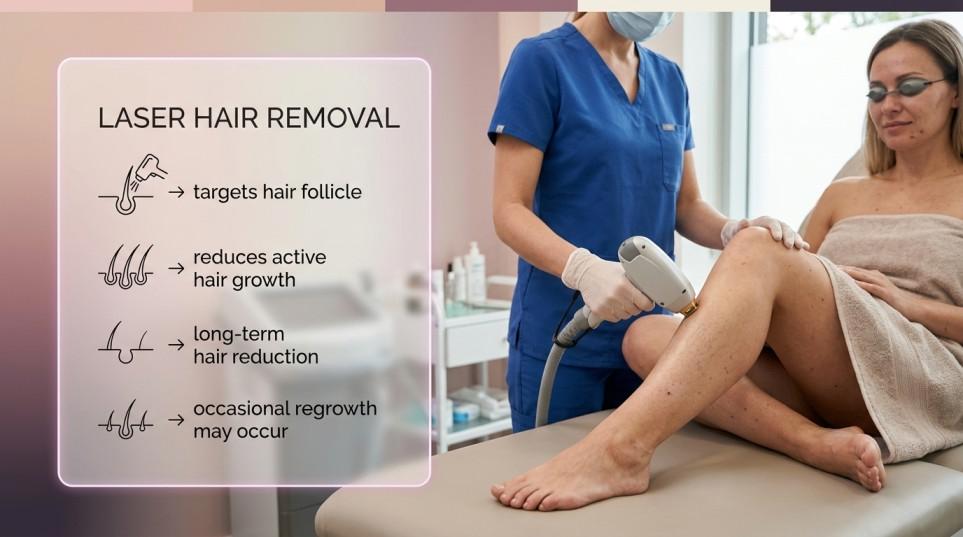
Laser hair removal does not remove hair permanently in the sense of eliminating every follicle for life. The FDA clears it for “permanent hair reduction,” a long-term, stable decrease in the number of hairs that regrow after a complete treatment series. Follicles that are successfully destroyed do not regrow hair, but some regrowth from other follicles is still possible over time.
If you're researching laser hair removal, chances are you've seen it advertised as a permanent solution. You may have also come across reviews or stories mentioning hair returning months or years later, and that mix of messaging can be confusing to sort through.
The honest answer sits between those two ideas. Laser hair removal permanently destroys the follicles it successfully targets during treatment, and for most people that adds up to a dramatic, long-lasting reduction in hair growth. It does not guarantee that every single follicle is eliminated forever, and several specific factors influence how stable your results stay over the years.
Understanding this distinction matters before you commit to a treatment plan. It shapes how many sessions to expect, what results look like five or ten years down the road, and whether occasional touch-ups will likely become part of your routine.
The sections below explain what actually happens to a hair follicle during treatment, why hair sometimes returns even after a full series, and what determines how long your results last.
The short answer depends on how you define “permanent.” The distinction the FDA draws between removing hair and reducing it is the foundation for realistic expectations.
Permanent hair removal means eliminating hair from a treated area completely, with no regrowth. Permanent hair reduction means a significant, long-term decrease in the number of hairs that grow back, without claiming that regrowth is impossible. Laser hair removal falls into the second category. Hair that does return is typically finer, lighter, and far less noticeable than it was before treatment.
The FDA's standard for clearing laser hair removal devices defines permanent hair reduction as a long-term, stable decrease in the number of hairs regrowing, measured at 6, 9, and 12 months after finishing a treatment series. That stability has to outlast the hair's natural growth cycle, which is why a single session, or even a few, isn't enough to demonstrate lasting results. This is the standard laser device manufacturers must meet to market equipment for hair reduction in the United States.
No laser device or provider can promise that every hair follicle in a treatment area will stop producing hair forever. Hair grows in cycles, and only follicles in an active growth phase respond well to laser energy at the time of treatment. Some follicles stay dormant through an entire series and can activate later. Hormonal changes can also switch on follicles that were never an issue before. These are normal biological realities, not signs that a treatment failed.
Understanding what the laser actually does inside the follicle explains both why results last and why they aren't absolute.
Laser hair removal works by directing concentrated light energy at the melanin, the pigment, inside the hair. The hair absorbs that light and converts it into heat, which travels down to the follicle and damages the structures responsible for producing new hair. When that damage is significant enough, the follicle can no longer generate a hair, and the destruction is permanent for that specific follicle. Because the laser relies on pigment to work, it's most effective on hair that contains enough melanin to absorb the light efficiently.
Hair grows in three phases: anagen, the active growth phase; catagen, a brief transition; and telogen, a resting phase. Laser energy is most effective on hair in the anagen phase, since that's when the follicle is most connected to its blood supply and contains the most pigment. At any given time, a portion of the hair in a treatment area sits in catagen or telogen and won't respond well to that particular session. This is why laser hair removal requires a series of sessions spaced several weeks apart, timed to catch hair as it cycles into active growth.
Once a full series is complete, most people see results that last well beyond the treatment period itself, though the timeline and stability vary from person to person.
Most treatment plans call for a series of sessions, often spaced several weeks apart, to account for the hair growth cycle described above. Published clinical research on laser hair removal commonly reports reduction in the range of roughly 70 to 90 percent after a complete series, though the exact outcome depends on hair color, skin tone, treatment area, and the specific laser technology used. Follicles that are successfully destroyed during that series stop producing hair permanently. You can learn more about what a treatment series involves on our laser hair removal page.
When hair does return after a completed series, it's usually not a return to the original density or thickness. Regrowth is typically finer, lighter in color, and slower growing than the hair that was there before treatment, since it often comes from follicles that were only partially affected or that stayed dormant during the original series. Full-density regrowth in a properly treated area is uncommon.
Many people benefit from occasional touch-up sessions months or years after completing their initial series, particularly in areas influenced by hormones. These sessions are typically far less involved than the original series and address new or reactivated follicles rather than starting treatment over. How often touch-ups make sense varies from person to person, which is something to talk through directly with your provider during a consultation.
Ready to take the next step? Book a consultation with a qualified permanent makeup artist.
Book Now
Regrowth after laser hair removal is rarely a sign that the treatment didn't work. It usually comes down to one of a few specific factors.
Conditions and life events that raise androgen levels, hormones linked to hair growth, can activate follicles that were previously inactive or cause existing hair to grow back thicker. Pregnancy, polycystic ovary syndrome (PCOS), thyroid disorders, and menopause are common examples. Hair growth changes during pregnancy typically settle down within several months postpartum, while conditions like PCOS can cause ongoing stimulation of new follicles that may call for more frequent maintenance.
Hormone levels shift naturally with age, and those shifts can change hair growth patterns in certain areas even years after a successful laser series. This is especially common around menopause, when some women notice new facial hair growth. Laser hair removal never had the chance to address those particular follicles the first time around, since they weren't active yet.
Not every hair follicle in a treatment area is actively producing hair at any given time. Some remain dormant for months or years and were never exposed to enough laser energy to be affected, simply because they weren't in an active growth phase during any session in the original series. When a dormant follicle eventually activates, it can look like new hair, even though the laser never treated that particular follicle.
Stopping a series early, skipping sessions, or spacing treatments outside the interval your provider recommends leaves more follicles untreated. Since laser hair removal depends on catching hair in its active growth phase, consistent, appropriately timed sessions give the treatment the best chance to address as many follicles as possible across the full course of the series.
A handful of individual factors have the biggest influence on how long laser hair removal results last.
Because laser hair removal works by targeting melanin, dark, coarse hair generally responds best and holds results longer. Light blonde, gray, red, or very fine hair contains less pigment, absorbs less laser energy, and typically sees a more limited or shorter-lived reduction. This is a physical limitation of how the technology works, not a difference in treatment quality.
Skin tone affects how a laser distinguishes hair from the surrounding skin, since both hair and skin contain melanin. Providers select laser settings, and in some cases different wavelengths, based on an individual's skin tone to treat effectively and safely. This is something your provider will assess and account for during your consultation and treatment planning.
Different parts of the body have different hair growth cycles and different levels of hormonal sensitivity, both of which affect how long results last in that specific area. The next section covers how this plays out across common treatment areas.
Because each session only affects hair that happens to be in its active growth phase at that time, sticking to the interval your provider recommends between sessions gives the series the best chance to reach the maximum number of follicles. Spacing sessions too far apart or stopping early tends to leave more hair untreated and can shorten how long results last.
Ready to take the next step? Book a consultation with a qualified permanent makeup artist.
Book Now
Results can vary meaningfully from one treatment area to another, largely because of differences in hormonal sensitivity and hair growth cycles.
Face and Neck
The chin, upper lip, and jawline are among the more hormonally sensitive areas on the body, which makes them more prone to new hair growth even after a successful series. Many people treating facial areas find that periodic touch-up sessions are a normal part of maintaining results long-term.
Legs and Arms
Legs and arms are generally less influenced by hormonal changes than facial or hormonally sensitive areas, and results here tend to stay more stable over time with fewer touch-ups needed.
Underarms
Underarms typically respond well to laser hair removal and tend to hold results steadily, though some hormonal influence is still possible, particularly around major hormonal changes like pregnancy or menopause.
Bikini Area
The bikini area often contains coarse, dark hair that responds well to laser treatment, but it's also somewhat hormonally reactive. Occasional touch-ups, similar to facial areas, are common for maintaining results here long-term.
Back and Chest
Back and chest hair, particularly in men, tends to be more strongly influenced by androgen levels, which can make regrowth in these areas more likely to be tied to hormonal factors. These areas may call for more sessions in the original series or more frequent maintenance than less hormonally active areas.
For anyone weighing hair removal options specifically for how permanent the results are, it helps to understand how laser and electrolysis actually differ.
Laser hair removal uses light energy absorbed by melanin to damage hair follicles across a treatment area, letting a provider treat many hairs in each pulse. Electrolysis works differently: a fine probe is inserted into each individual hair follicle, and a small electrical current is applied directly to the follicle to destroy its ability to regenerate. Because electrolysis doesn't rely on pigment contrast, it can be used on any hair color or skin tone, though it treats one follicle at a time and is generally slower for covering larger areas.
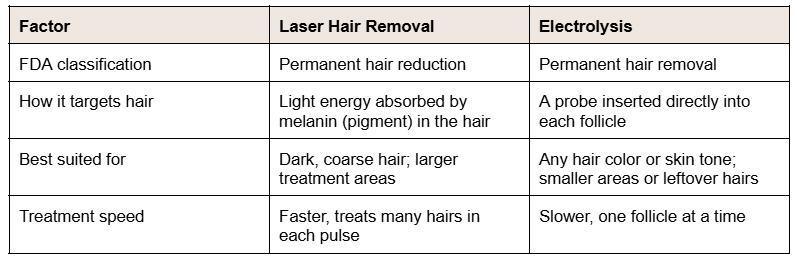
Electrolysis is the only hair removal method the FDA and the American Medical Association recognize as achieving permanent hair removal rather than reduction. Because it destroys each follicle's ability to regenerate directly, a follicle that's successfully treated does not produce hair again. That said, electrolysis still typically requires multiple treatments per follicle, since not every follicle is fully destroyed on the first attempt.
Because laser hair removal is less effective on light, fine, or gray hair, some people turn to electrolysis to address hair that laser couldn't fully treat, or to target isolated hairs that return in hormonally sensitive areas after a laser series. Which approach, or combination of approaches, makes sense depends on your hair type, treatment area, and goals, which is best worked through with a provider who can assess your specific situation.
Laser hair removal isn't permanent in the strictest sense of eliminating every hair forever, but it does permanently destroy the follicles it successfully targets, and for most people that means a substantial, long-lasting reduction in hair growth. What determines how stable your results stay over time comes down to your hair color and thickness, your skin tone, the treatment area, and biological factors like hormonal changes that are outside anyone's control.
At Symetrie Studio Spa, we help clients throughout Youngsville, Lafayette, and the greater Acadiana area understand what realistic results look like for their hair type and treatment goals before they begin. If you're trying to decide whether laser hair removal is right for you, we welcome you to schedule a complimentary consultation to discuss your goals and get a personalized treatment plan. You can also explore our full range of aesthetic services on our website to see how laser hair removal fits alongside your other skincare and beauty goals.
Ready to take the next step? Book a consultation with a qualified permanent makeup artist.
Book Now