What a HydraFacial Cannot Treat
This section matters more than the benefits list, because unmet expectations are the most common reason people feel disappointed by a treatment that worked exactly as designed.
Concerns That Need Deeper Resurfacing Treatments
A HydraFacial works at the surface. The following concerns do not respond to it in any meaningful way:
- Indented or atrophic acne scars. These involve lost tissue below the surface. The American Academy of Dermatology lists laser resurfacing, microneedling, chemical peels, fillers, and minor surgical techniques as the treatments used for depressed scarring, matched to scar type.
- Deep or static wrinkles. Lines visible when your face is at rest reflect structural change, not surface dryness.
- Moderate to severe or cystic acne. Inflamed lesions need medical management. Suction and exfoliation over active inflammation can aggravate it.
- Melasma and stubborn hyperpigmentation. These need a targeted approach, often including strict sun protection and prescription or professional-grade pigment treatment.
- Facial volume loss and skin laxity. No topical or surface treatment addresses these.
If one of these is your primary concern, a HydraFacial can still be a reasonable part of your routine, but it should not be the treatment you are counting on. Symetrie's skin care services include microneedling, VI Peel, dermaplaning, and Diamond Glow, and the AAD's overview of microneedling is a useful starting point if scarring is what brought you here. A consultation is the practical way to sort out which of those actually matches your concern.
When to Postpone or Avoid a HydraFacial
Timing matters. At Symetrie Studio Spa, we recommend waiting if you:
- Are pregnant or nursing (a precaution, since safety data on some serum ingredients is limited)
- Have active cold sores or any skin infection
- Have used Accutane (isotretinoin) within the past six months
- Have had a chemical peel or laser treatment in the past two weeks
Also worth raising before you book: active sunburn or windburn, an ongoing rosacea or eczema flare, open lesions in the treatment area, recent facial waxing, known allergies to treatment ingredients, and any prescription retinoid you are using, which most providers ask you to pause for a few days beforehand. Recent injectables typically warrant a short wait as well.
These are provider protocols and general caution rather than formal medical contraindications in every case. If you have a diagnosed skin condition or take medication that affects your skin, your dermatologist or prescribing physician is the right person to confirm timing.
What Happens During a HydraFacial?
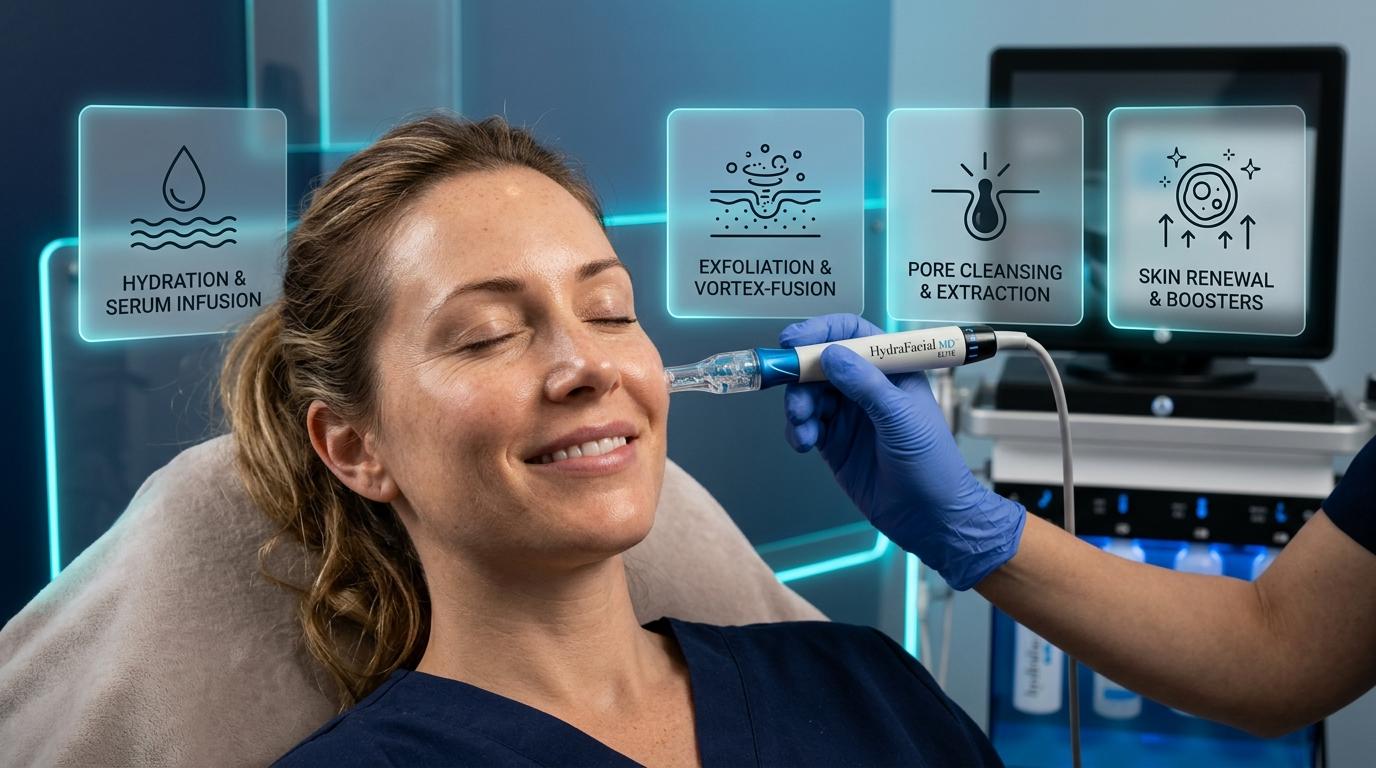
The treatment itself is straightforward, and the experience is closer to a facial than a procedure. Signature treatments at Symetrie run about 30 minutes, Deluxe 45 to 60 minutes, and Platinum 60 to 75 minutes with lymphatic drainage and neck and décolleté included.
Cleanse and Peel
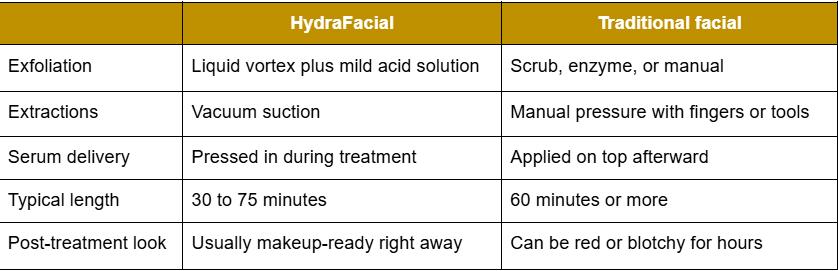
Your esthetician cleanses the skin, then works the wand over your face in sections. You will feel light suction and cool liquid. The mild glycolic and salicylic solution may produce a brief tingle, particularly around the nose. Nothing about this step should be uncomfortable, and the strength can be dialed down if it is.
Extract and Hydrate
The tip changes and the suction increases slightly for extractions, concentrated wherever congestion is worst. This is the step people expect to dislike and usually do not. It feels like firm pressure and pulling rather than pinching. The hydrating solution runs at the same time, so the skin never dries out mid-treatment.
Fuse and Protect
The final pass delivers antioxidants, peptides, and hyaluronic acid. Boosters get added at this stage if you have chosen one, and at Symetrie those include Murad Retinol, Circadia Vitamin C, Dermabuilder Peptide, Britenol Brightening, and JLO Beauty Glow. LED therapy is included with our treatments, and add-ons like dermaplaning, Lip Perk, and Eye Perk are applied around this point.
Ask which booster your esthetician recommends and why. Booster choice is where the treatment gets tailored to your actual concern, and it is an easy question to forget in the moment.
When Will You See Results?
What to Expect After One Treatment
Same day. Skin usually looks brighter and feels smoother immediately, with visibly cleaner pores. Some people notice mild pinkness for an hour or two, and most can apply makeup right away.
One treatment gives you a good result, not a transformed one. What it will not do is clear existing breakouts overnight or change anything structural.
How Long Results Last
Results generally peak in the first few days and then taper. Most people find the hydrated, smooth look holds for around a week, with texture improvement lasting somewhat longer. Pores begin refilling on their own schedule regardless of what you do.
How long yours last depends on skin type, oil production, sun exposure, and how consistent your home routine is. Oily skin tends to see congestion return faster.
How Often You Should Get a HydraFacial
Monthly is the most common recommendation, and it is what we suggest for most clients at Symetrie. That interval roughly matches the skin's natural turnover cycle and keeps congestion from rebuilding between visits.
Two useful variations. If you are treating a specific concern like persistent congestion or rough texture, a series of monthly treatments over about three months gives the cumulative effect a fair test. If your skin is already in good condition, every six to eight weeks as maintenance is often enough. For a wedding, a photo session, or an event, book two to three days ahead rather than the day before, so any temporary pinkness has settled and the hydration has fully taken hold.
How to Maintain Your Results Between Treatments
The treatment resets your skin's surface. What you do in the following weeks determines how long that lasts.
- Use a daily broad-spectrum sunscreen, which protects both your results and the pigmentation you are trying to avoid
- Keep a hydrating product with humectants in your routine rather than relying on the treatment alone
- Do not over-exfoliate at home; you are working against a professionally exfoliated surface and can compromise your barrier
- Give any prescription actives a few days after treatment before restarting
- Tell your esthetician what changed and what did not, so the next session can be adjusted
Downtime and What to Expect Afterward
What to Expect Immediately After Treatment
There is no recovery period in the usual sense. Most people return to work or their day straight away, and makeup can generally go on immediately. Skin often feels tighter and smoother to the touch, and looks slightly dewy for the first hour or so.
Plan around one thing: heat and friction. Skip the workout, sauna, and hot tub for the rest of the day, and avoid direct sun exposure while your skin is freshly exfoliated.
Common Temporary Side Effects
Most people experience nothing beyond mild pinkness that fades within a couple of hours. Some report temporary tightness or a slight sensitivity to products they usually tolerate. Occasionally, clearing congested pores brings existing blockages to the surface as small breakouts in the following days, which typically settle on their own.
Reactions beyond this are uncommon but possible, particularly with sensitive skin or a reaction to a serum ingredient. Persistent redness, burning, swelling, or irritation that lasts more than a day or two warrants a call to your provider.
Conclusion
A HydraFacial earns its reputation on a specific promise: better hydration, cleaner pores, smoother texture, and brighter-looking skin, delivered comfortably and without downtime. Judged against that promise, it delivers consistently. Judged against deep scarring, established wrinkles, or melasma, it was never the right tool, and no amount of frequency changes that.
The useful question is not whether HydraFacials work. It is whether the concern that brought you here lives at the surface of your skin or below it. That is genuinely hard to assess from the outside, and it is the single thing most worth getting right before you spend money on a treatment plan.
We are glad to help you work that out. Symetrie Studio Spa offers complimentary consultations at our Youngsville studio, serving clients across Lafayette, Broussard, Milton, and the wider Acadiana area. Book online or call us at (337) 534-0852, and we will talk through what your skin actually needs, including the honest answer if a HydraFacial is not it.